She was an education pioneer. At 108, Edith Renfrow Smith shares her life lessons.
Share
Explore Our Galleries









Breaking News!
Today's news and culture by Black and other reporters in the Black and mainstream media.
Ways to Support ABHM?
By Claretta Bellamy, NBC News
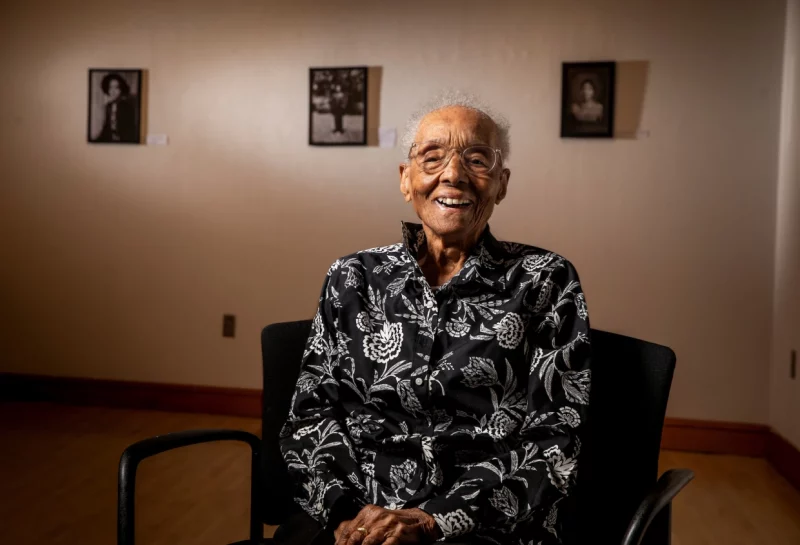
At 108, Edith Renfrow Smith can still recall memories from her childhood in Grinnell, Iowa, as if they happened yesterday. While some of those memories have blurred over time, what’s clear are the people in them, like her grandfather, who persevered through some of life’s greatest obstacles.
“My grandfather was a runaway slave,” said Renfrow Smith, who lives in Chicago. She said she was not sure when he met her grandmother, but they settled in Grinnell in 1859 and bought a piece of property, beginning her family’s legacy in Grinnell and in Iowa more broadly.
Renfrow Smith, a retired elementary school teacher, said much of her life journey was motivated by those in her family who grew up in the struggle of poverty and racism. Throughout her life, she broke barriers in white spaces, becoming the first Black woman to graduate from Grinnell College in 1937. Last December, the liberal arts school honored Renfrow Smith by naming one of its buildings Renfrow Hall, a residence hall set to open in fall 2024. Since attending the college over 80 years ago, she said that she’s witnessed the college change, and that she is “so glad” to have a building named in her honor.
“It’s nice to honor people before they’re dead and in the cemetery,” Renfrow Smith quipped.
Born just before World War I in 1914, Renfrow Smith along with her five siblings were one of the few Black families living in Grinnell, which had a population of 5,362 in 1920, according to Iowa’s State Data Center. Her mother, Eva Renfrow, worked as a laundress to support their family while her father, Lee Renfrow, worked as a cook. Renfrow Smith said making money wasn’t easy because the work wasn’t always steady. “He was doing any little job that he could find to make a dime,” she said of her father.
[…]
Renfrow Smith’s family was also the first Black family to own property in the county, Beauboeuf-Lafontant added, including her great-uncle who owned 300 acres by the end of the 19th century. All the information the university acquired about Renfrow Smith’s family was given orally by Renfrow Smith, as well as court records and census documents.
Beauboeuf-Lafontant also said that Renfrow Smith’s family history makes her think about other Black families who have passed down their history to each generation.
Head to the original article to read those thoughts.
Smith is old enough to remember the Jim Crow era.
Comments Are Welcome
Note: We moderate submissions in order to create a space for meaningful dialogue, a space where museum visitors – adults and youth –– can exchange informed, thoughtful, and relevant comments that add value to our exhibits.
Racial slurs, personal attacks, obscenity, profanity, and SHOUTING do not meet the above standard. Such comments are posted in the exhibit Hateful Speech. Commercial promotions, impersonations, and incoherent comments likewise fail to meet our goals, so will not be posted. Submissions longer than 120 words will be shortened.
See our full Comments Policy here.