Statue to ‘remarkable’ woman who escaped slavery
Share
Explore Our Galleries









Breaking News!
Today's news and culture by Black and other reporters in the Black and mainstream media.
Ways to Support ABHM?
Jane Downs, BBC
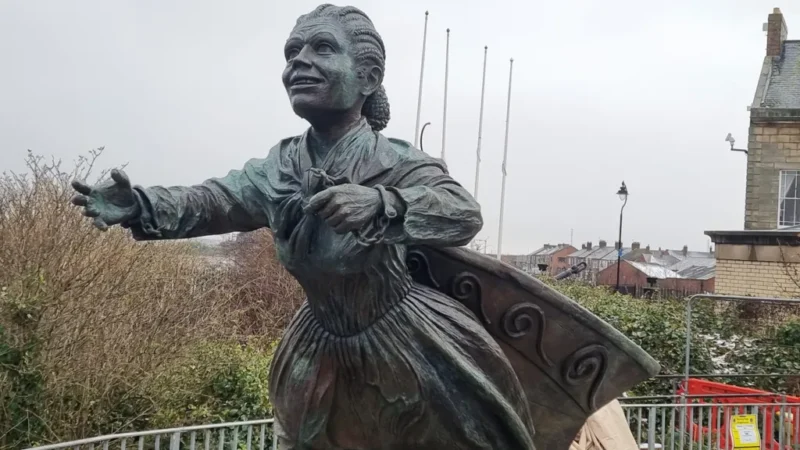
A statue to a “remarkable and brave” woman who fled slavery and torture in the US has been unveiled in the fishing town in northern England where she found freedom.
Mary Ann Macham spent weeks hiding in woods in Virginia before stowing away on a ship, eventually arriving in North Shields in the early 1830s.
She was taken in by a Quaker family, married a local man and remained in the town until she died aged 91.
The bronze figure, created by North Shields-based artist Keith Barrett, stands at the top of the Riverside Embankment Walkway, overlooking the sea close to where she once lived.
Mary Ann gave an account of her escape which was written down by the Spence family who supported her when she arrived in North Shields.
She had been born in Middlesex County in May 1802, her father the son of an estate owner and her mother one of those enslaved by them.
Raised by an aunt, her death saw Mary Ann sold by a relative and sent, aged 12, to a farm with 200 other enslaved people.
For 17 years she was subject to regular whippings and torture, but took her chance one night, prising her way out of a locked room and hiding for weeks while slavers and dogs hunted her.
Keep reading to learn about Mary Ann’s escape.
Learn about the enslavement that people like Macham escaped from.
Comments Are Welcome
Note: We moderate submissions in order to create a space for meaningful dialogue, a space where museum visitors – adults and youth –– can exchange informed, thoughtful, and relevant comments that add value to our exhibits.
Racial slurs, personal attacks, obscenity, profanity, and SHOUTING do not meet the above standard. Such comments are posted in the exhibit Hateful Speech. Commercial promotions, impersonations, and incoherent comments likewise fail to meet our goals, so will not be posted. Submissions longer than 120 words will be shortened.
See our full Comments Policy here.