Race, Class and Schools
Share
Explore Our Galleries









Breaking News!
Today's news and culture by Black and other reporters in the Black and mainstream media.
Ways to Support ABHM?
By Kevin P. Chavous, Huffington Post
For most African-Americans, the Brown vs. Board of Education Supreme Court decision is like the Holy Grail.
[…]

The primary thesis of Brown back in 1954 was that segregated schools exacerbated the inherent second class treatment of African-Americans that was a natural by-product of slavery. To address this problem, the Brown Court reasoned, the U.S. government had a responsibility to end segregated schools and the states were ordered to integrate their schools with “all deliberate speed.”
But, what do you do when the blood, sweat and tears of your history clashes with the realities of today?
[…]
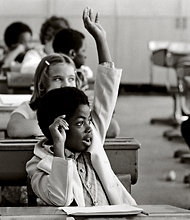
The average white child in America attends a school that is 77 percent white, and where just 32 percent of the student body lives in poverty. The average black child attends a school that is 59 percent poor but only 29 percent white. The typical Latino kid is similarly segregated; with a school population made up of 57 percent poor and 27 percent white. But increasingly, a growing educational gulf exists between the haves and have nots in our country, irrespective of race.
[…]
Does forced integration of races and classes in our schools today have a role in helping us get better educational outcomes for all?
Read more here.
Learn about how schools are still segregated.
Comments Are Welcome
Note: We moderate submissions in order to create a space for meaningful dialogue, a space where museum visitors – adults and youth –– can exchange informed, thoughtful, and relevant comments that add value to our exhibits.
Racial slurs, personal attacks, obscenity, profanity, and SHOUTING do not meet the above standard. Such comments are posted in the exhibit Hateful Speech. Commercial promotions, impersonations, and incoherent comments likewise fail to meet our goals, so will not be posted. Submissions longer than 120 words will be shortened.
See our full Comments Policy here.