Protesters Against Police Brutality Begin 9-Day March From New York To D.C.
Share
Explore Our Galleries









Breaking News!
Today's news and culture by Black and other reporters in the Black and mainstream media.
Ways to Support ABHM?
By Christopher Mathias, the Huffington Post
NEW YORK — A march from New York City to Washington, D.C., to protest police brutality started Monday morning in Staten Island — the borough where Eric Garner died last summer after being put into a chokehold by a New York police officer.
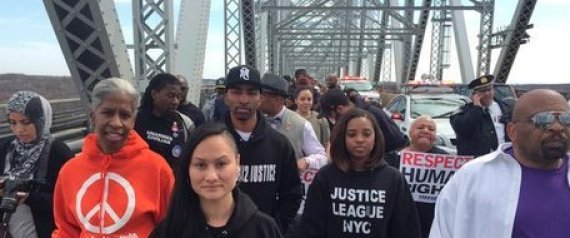
About 100 protesters gathered at the foot of the Outerbridge Crossing in preparation for the nine-day, 250-mile trek. Many wore T-shirts bearing Garner’s famous last words, “I can’t breathe,” and others held signs reading “#BlackLivesMatter.”
Sade Swift, a 19-year-old New School student, told The Huffington Post she was marching because she’s “tired of creating hashtags” for unarmed men of color killed by the police: #EricGarner. #MichaelBrown. #RamarleyGraham. #TamirRice.#AkaiGurley. And, most recently, #WalterScott.
“I’m tired of seeing all these people that look like me on the news, so that’s why I’m marching,” said Swift, who grew up in Washington Heights…
Swift is a member of The Justice League, the New York-based organization behind the event, dubbed “The March 2 Justice.” About 100 protesters are making the entire journey, spokeswoman Lindsey Wagner told HuffPost, and others will join in for different legs of the trip along the way…
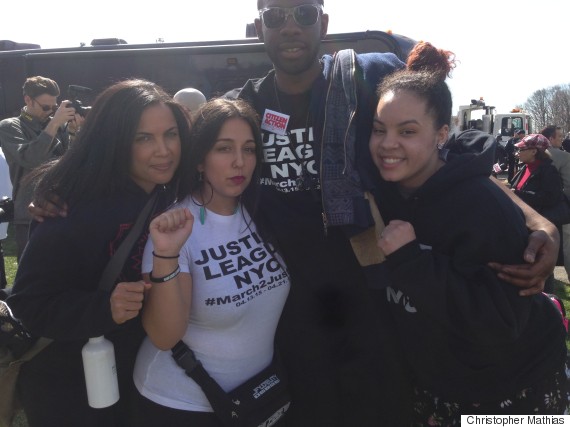
Carmen Perez, the Justice League march director, told HuffPost that when the protest ends in Washington on April 21, organizers will hold a rally on the National Mall with musical performances.
“We want to shed light on the injustices that are happening in different communities, particularly around police brutality, and the mass incarceration of our black and brown communities,” Perez said…
The Justice League is pushing for the passage of three federal bills during the march: the Juvenile Justice and Delinquency Prevention Act, which would create funding to improve conditions in local and state juvenile justice programs; the End Racial Profiling Act, which would prohibit police from profiling anyone based on their race, ethnicity or national origin; and the Militarization Bill, which would limit police departments’ ability to purchase military equipment from the Department of Defense.
Read the full article here.
Read more Breaking News here.
Comments Are Welcome
Note: We moderate submissions in order to create a space for meaningful dialogue, a space where museum visitors – adults and youth –– can exchange informed, thoughtful, and relevant comments that add value to our exhibits.
Racial slurs, personal attacks, obscenity, profanity, and SHOUTING do not meet the above standard. Such comments are posted in the exhibit Hateful Speech. Commercial promotions, impersonations, and incoherent comments likewise fail to meet our goals, so will not be posted. Submissions longer than 120 words will be shortened.
See our full Comments Policy here.