Progressive Brandon Johnson wins Chicago mayor’s race
Share
Explore Our Galleries









Breaking News!
Today's news and culture by Black and other reporters in the Black and mainstream media.
Ways to Support ABHM?
By Natasha Korecki, NBC News
The Cook County commissioner had the backing of the powerful Chicago Teachers Union and ran on a platform of addressing racial and economic disparities.
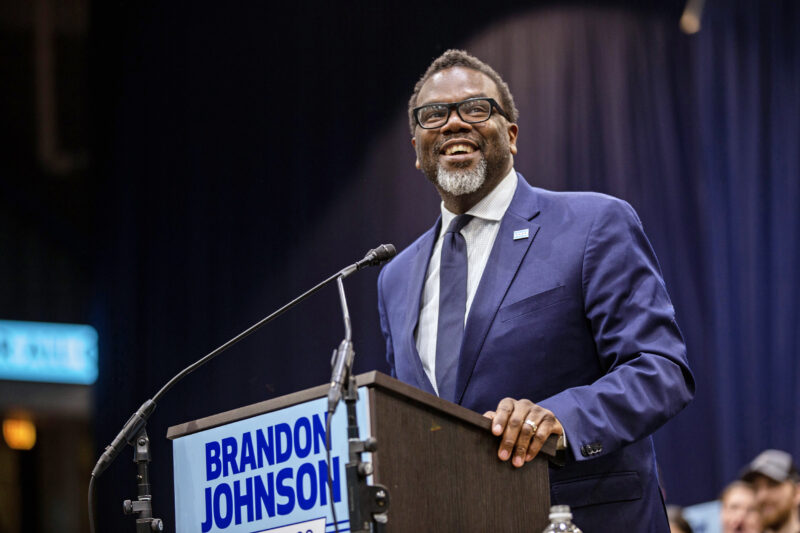
Brandon Johnson will be the next mayor of Chicago, NBC News projected Tuesday, marking a stunning turn for a staunch progressive and former teacher whose campaign leaned into messages of racial and economic disparities and who overcame blowback over past comments about decreasing police funding.
Johnson defeated the well-financed, tough-on-crime moderate Paul Vallas, a former CEO of the Chicago Public Schools who promised to immediately bulk up the Chicago police ranks to curb a crisis of gun violence.
Vallas told his supporters Tuesday night that he called Johnson and “told him I absolutely expect him to be the next mayor.”
The victory caps a meteoric rise for Johnson, 46, a Cook County commissioner, an activist and a member of the Chicago Teachers Union, who in the first round of the mayoral race, held Feb. 28, had been polling in fifth place before he finished second, behind Vallas.
In his victory speech, Johnson immediately gave a nod to the more than 270,000 people who did not support him.
“To the Chicagoans who did not vote for me,” Johnson said. “I care about you, I value you and I want to hear from you. I want to work with you. And I’ll be the mayor for you too.”
Johnson ran on a platform of taxing the wealthy to boost citywide services and investing in neighborhoods and schools across the city. He walked back past comments about slashing funding to police departments, saying that he wanted to bolster the ranks of detectives but that he also wanted to invest in mental health response services.
In his remarks Tuesday night, Johnson leaned heavily into new beginnings, acknowledging his win came on the same day of the 55th anniversary of Martin Luther King Jr.’s assassination, saying it served as symbolism for a new Chicago.
“Today, we did not just acknowledge the assassination of a dreamer,” he said. “Today the dream is alive, so today we celebrate the revival and the resurrection of the city of Chicago.”
“Let’s take this bold progressive movement around these United States of America. Chicago, we can show the country, we can show the world what’s possible when we stand on our values,” he added. “We don’t have to choose between toughness and compassion, between the care of our neighbors and keeping our people safe. If tonight is proof of anything, it is proof that those old false choices do not serve this city longer…”
“The conversation that we’re having right now is about ‘What do safe American cities look like now in this country?’” Johnson said in a recent interview. “What they look like is that they have fully funded neighborhood schools, good paying jobs and affordable housing, reliable and safe public transportation.”
“This race is about doing what works,” he added. “And what works is that we invest in people. It’s data-proven that the greatest predictor of a safe community is a community that is fully loved, supported and invested in.”
Click here to read the whole article and see why Johnson won
To find out about more Chicago’s past and current issues with community support, Click here
Visit the BHM exhibit on Racial Repair and Reconciliation to find out ways that we as people and as a society can work to put an end to racial inequality
Comments Are Welcome
Note: We moderate submissions in order to create a space for meaningful dialogue, a space where museum visitors – adults and youth –– can exchange informed, thoughtful, and relevant comments that add value to our exhibits.
Racial slurs, personal attacks, obscenity, profanity, and SHOUTING do not meet the above standard. Such comments are posted in the exhibit Hateful Speech. Commercial promotions, impersonations, and incoherent comments likewise fail to meet our goals, so will not be posted. Submissions longer than 120 words will be shortened.
See our full Comments Policy here.