Post-Baltimore, Most Americans Believe Unrest Was Just One Big Criminal Act
Share
Explore Our Galleries









Breaking News!
Today's news and culture by Black and other reporters in the Black and mainstream media.
Ways to Support ABHM?
By Charles D. Ellison, theRoot
The results are in: A majority of Americans think the Baltimore unrest was just another mad, black riot. The Pew Research Center surveyed the top five reasons an anxious public considered for the unrest, including anger over Freddie Gray’s death, frustration with police-community relations and the socioeconomic challenges. The poverty narrative didn’t stick, with 61 percent believing that “people were taking advantage of the situation to engage in criminal behavior.”
As expected, those attitudes differ sharply by race, with 50 percent of blacks blaming poverty as the reason, compared with 40 percent of whites (interestingly enough, a majority of African Americans—54 percent—also viewed the unrest as “criminal”). There’s also a nearly 10-point gap between whites and blacks when comparing perceptions on police-community relations: Most African Americans, 65 percent, believe that “tensions between the black community and police” contributed to the unrest, while just 56 percent of whites did. Instead, 66 percent of whites support the notion that it was just one more “wile out” in the hood.
These numbers are significant because they help in our routine evaluation of America on race, police conduct and a #BlackLivesMatter movement trying to find itself ahead of the next election. Polls help us put these experiences into context, especially as we struggle to understand the post-Baltimore public mood.
[…]
A just-released Public Religion Research Institute survey finds that there is massive disagreement between blacks (17 percent) and whites (46 percent) on whether people of color receive “equal treatment in the criminal-justice system.” But that is far fewer whites who agree that blacks get fair treatment than the 62 percent who believed it in the late ’90s.
Still, only 49 percent of whites, according to the Public Religion poll, think Freddie Gray’s death was part of a broader pattern of vicious anti-black police treatment, compared with 74 percent of blacks who do…
[…]
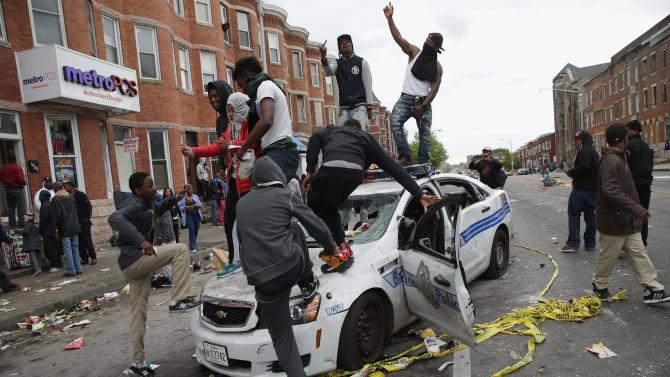
America, for the most part, may not be as sympathetic to the broader discussion on poverty, as well as the criminal-justice challenges resulting from it. Most whites, especially, don’t want to hear it. Brothers smashing police cars on infinite news loops didn’t help the cause, either, and there’s a larger concern that both Democratic and Republican presidential candidates in the next election cycle will sidestep systemic issues in favor of coddling white fear. Most polled (96 percent in the NBC/WSJ survey) are more worried about bracing for a long, hot summer of urban unrest than they are about finding solutions to prevent that from happening in the first place.
Read the full article here.
Read more Breaking News here.
Comments Are Welcome
Note: We moderate submissions in order to create a space for meaningful dialogue, a space where museum visitors – adults and youth –– can exchange informed, thoughtful, and relevant comments that add value to our exhibits.
Racial slurs, personal attacks, obscenity, profanity, and SHOUTING do not meet the above standard. Such comments are posted in the exhibit Hateful Speech. Commercial promotions, impersonations, and incoherent comments likewise fail to meet our goals, so will not be posted. Submissions longer than 120 words will be shortened.
See our full Comments Policy here.