On a Path to Expand the View of Blackness
Share
Explore Our Galleries









Breaking News!
Today's news and culture by Black and other reporters in the Black and mainstream media.
Ways to Support ABHM?
By Vivian Wang, The New York Times
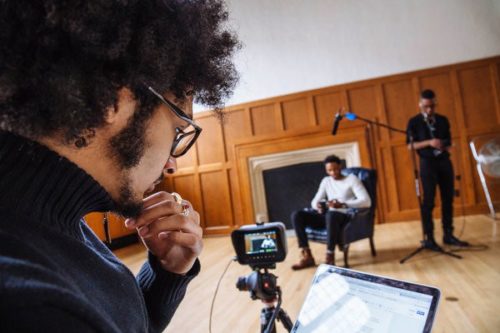
J. Joseph, foreground, prepares questions, while Clark Burnett adjusts his equipment before interviewing a student at the Afro-American Cultural Center at Yale.
(Credit
Michael M. Santiago for The New York Times)
It seems like hardly a week goes by without a headline about the collision of race, politics and education on American campuses, as policymakers, students and activists battle over hot-button words like diversity and fairness. Often, they speak about groups of people — black students, Latino students, Asian students — rather than focusing on individuals.
But it’s the individual stories that fascinate Clark Burnett and J. Joseph, rising seniors at Yale, who last month launched the second season of a documentary series exploring the perception of blackness. Each episode of “Now, In Color” features an interview with a student who settles into a comfortable chair, sips a hot beverage, and fields the opening question: “What’s in your cup?” From there, the filmmakers seek a portrait of his or her life — as a black student, but also as an athlete or daughter or friend.
The project started at Yale (where I also attended), but the budding filmmakers are searching the country for black people of all ages to feature in their third season. I recently talked with them about their video series. (Our conversation has been edited for clarity and length.)
Read the full interview here.
Read more Breaking News here.
View more galleries from the ABHM here.
Watch more from Clark Burnett and J. Joseph interview series Now, In Color here.
Comments Are Welcome
Note: We moderate submissions in order to create a space for meaningful dialogue, a space where museum visitors – adults and youth –– can exchange informed, thoughtful, and relevant comments that add value to our exhibits.
Racial slurs, personal attacks, obscenity, profanity, and SHOUTING do not meet the above standard. Such comments are posted in the exhibit Hateful Speech. Commercial promotions, impersonations, and incoherent comments likewise fail to meet our goals, so will not be posted. Submissions longer than 120 words will be shortened.
See our full Comments Policy here.