Missouri man who served 27 years in prison is freed as judge vacates his murder conviction
Share
Explore Our Galleries









Breaking News!
Today's news and culture by Black and other reporters in the Black and mainstream media.
Ways to Support ABHM?
By Andy Rose and Elizabeth Wolfe, CNN
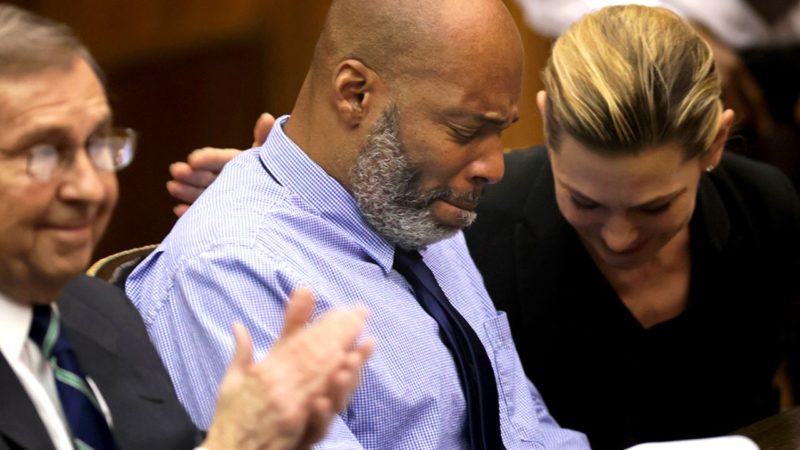
A Missouri man who has been serving a life sentence for nearly three decades was set free Tuesday after a judge ruled he is innocent and vacated his murder conviction.
Lamar Johnson was sentenced to life without the possibility of parole in 1995 after being convicted of murder in the death of Markus Boyd the year prior. At the time, police said Johnson and another man, Phillip Campbell, shot and killed Boyd.
But Johnson was given a new hearing after St. Louis Circuit Attorney Kimberly Gardner filed a motion last year saying his conviction was based in large part on false eyewitness testimony and accusing prosecutors and investigators of misconduct.
On Tuesday, Missouri Circuit Court Judge David Mason ruled that Johnson’s trial included “constitutional error” and said “there is clear and convincing evidence of Lamar Johnson’s actual innocence,” according to the judge’s order.
Johnson appeared to tear up in the courtroom as Mason announced his decision. Johnson smiled broadly as he left the courthouse and declined to speak to reporters.
“This is an amazing day that we showed that the city of St. Louis and the state of Missouri is about justice and not defending the finality of a conviction,” Gardner said following the ruling.
CNN has details about the case.
Sadly, exoneration can be traumatic, too.
Our breaking news page has more stories like this.
Comments Are Welcome
Note: We moderate submissions in order to create a space for meaningful dialogue, a space where museum visitors – adults and youth –– can exchange informed, thoughtful, and relevant comments that add value to our exhibits.
Racial slurs, personal attacks, obscenity, profanity, and SHOUTING do not meet the above standard. Such comments are posted in the exhibit Hateful Speech. Commercial promotions, impersonations, and incoherent comments likewise fail to meet our goals, so will not be posted. Submissions longer than 120 words will be shortened.
See our full Comments Policy here.