Military Weapons Used in Ferguson to Be Restricted by Obama Task Force
Share
Explore Our Galleries









Breaking News!
Today's news and culture by Black and other reporters in the Black and mainstream media.
Ways to Support ABHM?
By Lauren Victoria Burke, theRoot
Civilian law enforcement will be prohibited from receiving certain military weapons—including tanklike vehicles, assault rifles and grenade launchers.
President Barack Obama is moving to restrict the type of military-style equipment that police departments can have, according to a report from the President’s Task Force on 21st-Century Policing.
The task force was established Dec. 18, 2014, after the issue of police brutality received international attention in the wake of Michael Brown’s death by a Ferguson, Mo., police officer. Police used armored vehicles, assault rifles and other military gear in the small city of Ferguson during protests after Brown’s death.
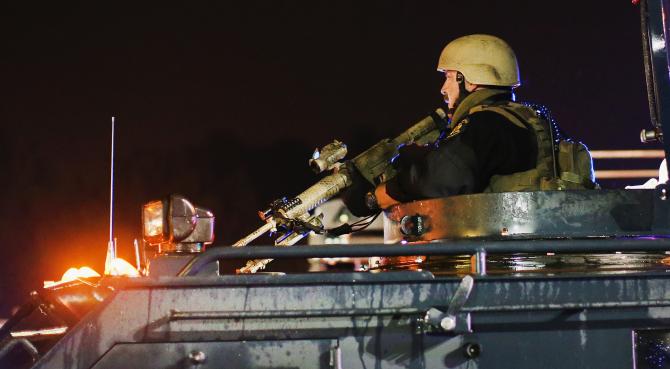
In the report, which is to be released later on Monday, the task force takes aim at police militarization. The report outlines a list of military equipment that is now prohibited for transfer to civilian law enforcement, including armored, tanklike vehicles that use a track system instead of wheels; grenade launchers; weaponized aircraft; and firearms over .50 caliber.
“Our review found that there wasn’t a single federal strategy but, rather, a different set of standards and a different set of rules by agencies for different programs, and no consistent standards for law-enforcement agencies that were seeking and requesting the equipment,” said Cecilia Muñoz, President Obama’s highest-ranking official on domestic policy, during a media call Sunday…
“The idea is to make sure that we strike a balance in providing the equipment which is appropriate and useful and important to keep local communities safe, while at the same time putting standards in place so that there’s a clear reason there was a transfer of that equipment, and so that there is clear training and safety procedures in place,” Muñoz said to reporters.
President Obama will also speak about communities that will be working to implement his task force’s recommendations, which include a focus on community policing, implementing body-camera pilot programs and better data collection…
Read the full article here.
Read more Breaking News here.
Comments Are Welcome
Note: We moderate submissions in order to create a space for meaningful dialogue, a space where museum visitors – adults and youth –– can exchange informed, thoughtful, and relevant comments that add value to our exhibits.
Racial slurs, personal attacks, obscenity, profanity, and SHOUTING do not meet the above standard. Such comments are posted in the exhibit Hateful Speech. Commercial promotions, impersonations, and incoherent comments likewise fail to meet our goals, so will not be posted. Submissions longer than 120 words will be shortened.
See our full Comments Policy here.