Meet Emilie Kouatchou, Broadway’s 1st Black Christine in ‘Phantom of the Opera’
Share
Explore Our Galleries









Breaking News!
Today's news and culture by Black and other reporters in the Black and mainstream media.
Ways to Support ABHM?
By Randi Richardson, NBC News
Kouatchou opens up about taking over a historic role and the significance of Black representation on Broadway.
Broadway’s groundbreaking musical “Phantom of the Opera” has once again made history.
The musical is the longest-running show on Broadway, celebrating 34 years last month. It marked the milestone by debuting its first Black Christine on Broadway, played by Emilie Kouatchou.
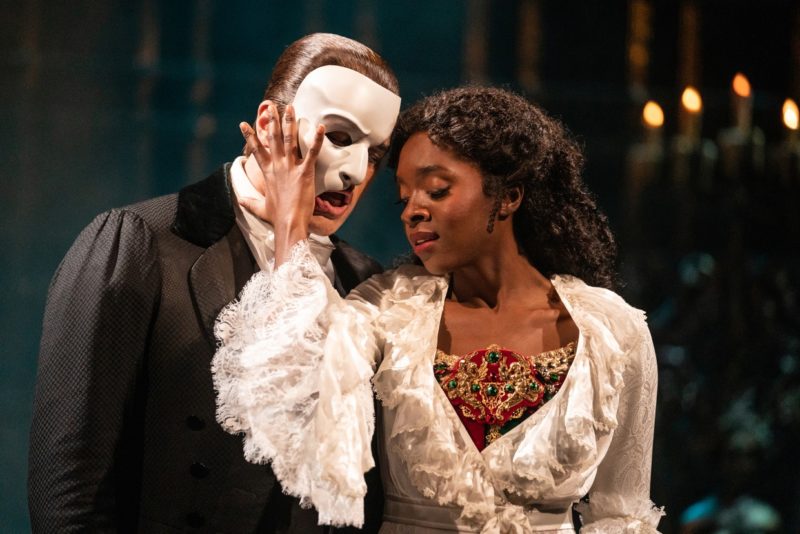
Photo credit: Matthew Murphy
In celebration of Black history, Kouatchou sat down with TODAY to discuss disrupting an industry set in its ways and the significance of Black representation on Broadway, especially in predominately white musicals and plays.
Based on Gaston Leroux’s 1910 novel, “Phantom of the Opera” tells the story of a love triangle that blossoms after two businessmen take ownership of a haunted opera house. The Phantom, a mysterious character who inhabits the rafters, sabotages the ongoing opera to get what he wants from the new owners. Christine — a young soprano — starts the musical with a small role in the show within the show, but becomes the Phantom’s love interest and he uses his influence to get her the lead role by any means possible.
“It was a big conversation when I was rehearsing first with our production supervisors. He was really adamant about making sure that Christine felt like me, and that I didn’t have to put on any sort of airs that I thought an ingenue character had to be or a Christine had to be,” she said. “This Christine feels very much close to me, and I relate a lot to her. I try and bring myself to her as much as I can even in just the inflection of my voice, something as simple as that. The temptation might be to inflect up … (but) it’s OK for her to have a more grounded lower voice if that’s true to me.
“So things like that; just remembering that although I do have to stay in the confines of the time period and in dialect, I can be as expressive as myself, Emilie.”
Read the full article here.
More Breaking News here.
Comments Are Welcome
Note: We moderate submissions in order to create a space for meaningful dialogue, a space where museum visitors – adults and youth –– can exchange informed, thoughtful, and relevant comments that add value to our exhibits.
Racial slurs, personal attacks, obscenity, profanity, and SHOUTING do not meet the above standard. Such comments are posted in the exhibit Hateful Speech. Commercial promotions, impersonations, and incoherent comments likewise fail to meet our goals, so will not be posted. Submissions longer than 120 words will be shortened.
See our full Comments Policy here.