Medical Apartheid
Share
Explore Our Galleries









Breaking News!
Today's news and culture by Black and other reporters in the Black and mainstream media.
Ways to Support ABHM?
By Amaya Rivera, Mother Jones magazine
Compelling, if at times gruesome, Medical Apartheid connects past medical experiments and the woeful current state of health care for blacks.
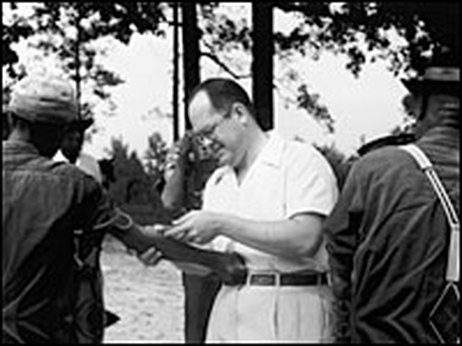
In this provocatively titled book, Harriet Washington argues that the infamous “Tuskegee Experiment”—the 40-year study in which black men with syphilis were allowed to die untreated so that their cadavers could be used for research—was not an isolated incident, but rather one example of the medical establishment’s long history of mistreating African Americans. Compelling, if at times gruesome, Medical Apartheid draws a connection between past medical experiments and the woeful current state of health care for blacks.
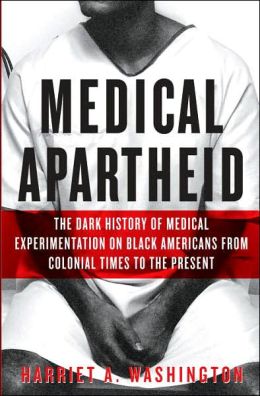
Medical Apartheid is peppered with chilling anecdotes of racist exploitation, curiosity, and control. There is the story of John Brown, a slave purchased in Georgia in the 1820s, whose owner, a doctor, blistered his legs and arms on a daily basis to see how deep his black skin went. Far from merely cataloging horrors, Washington, a journalist and former fellow in ethics at Harvard Medical School, also illustrates what she calls the “dual face” of these abuses, pointing out that the exploitation of black subjects made numerous medical advances possible. For example, Dr. Marion Sims, a 19th-century gynecological pioneer, was only able to achieve his breakthroughs by performing horrific surgeries without anesthesia on his female slaves….
One of the most harmful contemporary legacies of this history of abusive medical experimentation is that many African Americans are wary of participating in potentially life saving medical studies. A recent study in the American Journal of Law and Medicineestimated that only 1 percent of the nearly 20 million Americans enrolled in biomedical studies are black. This reluctance, though justified, has meant that blacks often miss out on the latest treatments and breakthroughs.
Read the full review here.
Listen to author Harriet Washington read from the book here.
Read more Breaking News here.
Comments Are Welcome
Note: We moderate submissions in order to create a space for meaningful dialogue, a space where museum visitors – adults and youth –– can exchange informed, thoughtful, and relevant comments that add value to our exhibits.
Racial slurs, personal attacks, obscenity, profanity, and SHOUTING do not meet the above standard. Such comments are posted in the exhibit Hateful Speech. Commercial promotions, impersonations, and incoherent comments likewise fail to meet our goals, so will not be posted. Submissions longer than 120 words will be shortened.
See our full Comments Policy here.