Len Chandler, an Early Fixture of the Folk Revival, Dies at 88
Share
Explore Our Galleries









Breaking News!
Today's news and culture by Black and other reporters in the Black and mainstream media.
Ways to Support ABHM?
By Neil Genzlinger, New York Times
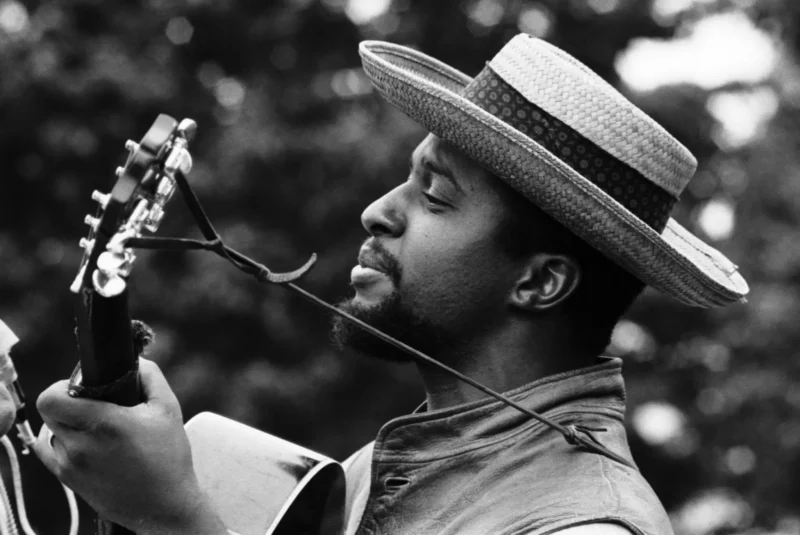
Len Chandler, who was an early fixture of the folk music revival that swept through Greenwich Village in the late 1950s and ’60s and who sang alongside Pete Seeger, Bob Dylan, Joan Baez and other higher-profile stars at civil rights marches and Vietnam War protests, died on Aug. 28 at his home in Los Angeles. He was 88.
Lew Irwin, a longtime friend who in the late 1960s brought Mr. Chandler to Los Angeles to provide music for an unusual new radio show he was creating, confirmed the death. He said Mr. Chandler had recently had several strokes.
Mr. Chandler was a classically trained oboist when he arrived in New York from Ohio, where he had graduated from the University of Akron in 1957, and met the singer Dave Van Ronk at the Folklore Center, a Greenwich Village shop that sold records, books and sheet music and was a gathering point for folk musicians.
[…]
Soon he was playing regularly at the Gaslight Cafe, which opened in 1958 and was later famous as a proving ground for Mr. Dylan and others.
“It was mainly a scene for poets,” Mr. Chandler said in an interview for the book “Folk Music: More Than a Song,” by Kristin Baggelaar and Donald Milton (1976), “and there wasn’t much happening for singers, except for me.”
An executive from the Detroit television station WXYZ saw him there and in 1959 hired him to be the featured musician on “The After Hours Club,” a late-night variety show. By the time Mr. Chandler returned to New York about six months later, the folk music scene was in full swing at the Gaslight, Folk City and other clubs.
Don’t forget to stop by our online exhibits.
Check out these black culture stories.
Comments Are Welcome
Note: We moderate submissions in order to create a space for meaningful dialogue, a space where museum visitors – adults and youth –– can exchange informed, thoughtful, and relevant comments that add value to our exhibits.
Racial slurs, personal attacks, obscenity, profanity, and SHOUTING do not meet the above standard. Such comments are posted in the exhibit Hateful Speech. Commercial promotions, impersonations, and incoherent comments likewise fail to meet our goals, so will not be posted. Submissions longer than 120 words will be shortened.
See our full Comments Policy here.