Legendary Blues Musician B.B. King Dead At 89
Share
Explore Our Galleries









Breaking News!
Today's news and culture by Black and other reporters in the Black and mainstream media.
Ways to Support ABHM?
By Jade Walker, The Huffington Post
[…]
Born Riley B. King in Berclair, Mississippi, and raised by his grandmother, the future “King of the Blues” purchased his first guitar for $15 when he was just 12 years old. He dropped out of school in the 10th grade, and spent much of his early years picking cotton and working as a tractor driver.
While he began singing in a gospel choir at church, the blues took root in King during his teen years. The blues is considered by many to be the only truly indigenous American music, and over time, King would become its foremost ambassador.
[…]
Although he originally played to all-black audiences, King’s distinctive voice soon won him fans the world over. Between the release of his landmark album “Live at the Regal” in 1965 — which would later be declared a recording worthy of preservation by the Library of Congress’ National Recording Registry — and the charting of his 1969 LP “Live and Well,” King became a true star. And by the late 1960s, he was making appearances on the “Ed Sullivan Show” and “The Tonight Show.”
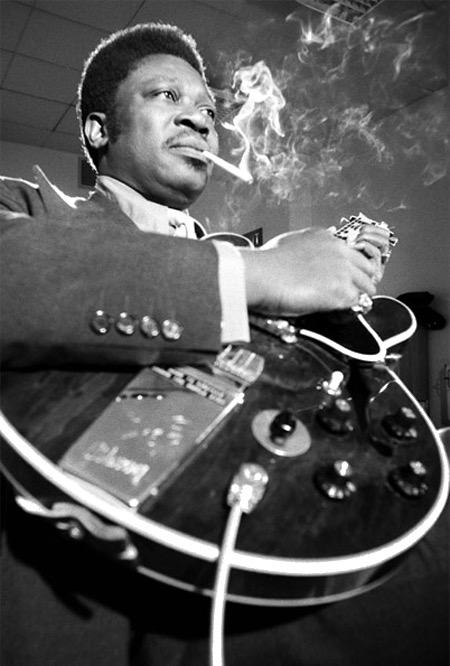
Playing on a Gibson ES-355 guitar he lovingly named Lucille, King would weave a musical tapestry of heartfelt soul and pain that masterfully fused elements of blues and jazz. These passionate sounds would not only enrapture audiences but influence many other artists, including Eric Clapton, Jimmy Page, Stevie Ray Vaughn and Jimi Hendrix.
“When I’m singing, I don’t want you to just hear the melody,” King told the AP in 2006. “I want you to relive the story, because most of the songs have pretty good storytelling.”
King won the first of his 15 Grammy Awards in 1951 and joined the Grammy Hall of Fame 47 years later. He was inducted into the Blues Hall of Fame in 1980, the Rock and Roll Hall of Fame in 1987 and the R&B Music Hall of Fame in 2014. Rolling Stone magazine also ranked him at No. 3 in its 2003 list of the 100 greatest guitarist of all time….
When he wasn’t making music, King loved to fly. He was a licensed pilot and until he turned 70, would fly himself to many of his gigs. The indefatigable performer was known for appearing in 250 to 300 concerts a year well into his 70s. Only declining health made him cut back his workload to about 100 shows annually, and those were not as well-received as his earlier shows. King officially launched a “farewell” world tour in 2006, yet remained active until almost the very end, appearing on television program and in music festivals.
Read full article here.
More Breaking News here.
Comments Are Welcome
Note: We moderate submissions in order to create a space for meaningful dialogue, a space where museum visitors – adults and youth –– can exchange informed, thoughtful, and relevant comments that add value to our exhibits.
Racial slurs, personal attacks, obscenity, profanity, and SHOUTING do not meet the above standard. Such comments are posted in the exhibit Hateful Speech. Commercial promotions, impersonations, and incoherent comments likewise fail to meet our goals, so will not be posted. Submissions longer than 120 words will be shortened.
See our full Comments Policy here.