‘How much press are you worth?’ New calculator tackles inequality in missing persons stories
Share
Explore Our Galleries









Breaking News!
Today's news and culture by Black and other reporters in the Black and mainstream media.
Ways to Support ABHM?
By David Bauder, Associated Press
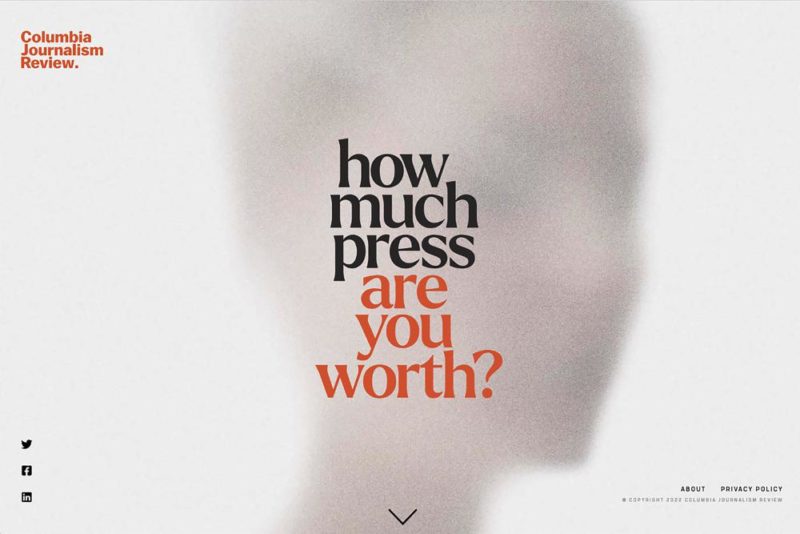
If you went missing, how much press would you be “worth”? The Columbia Journalism Review unveiled a tool on Thursday that calculates the number of stories your disappearance would net, based on demographics.
It sounds morbid but the exercise is designed to call attention to “missing white women syndrome,” the tendency of news organizations to pay relatively little attention to missing people who don’t fit that category.
The late journalist Gwen Ifill is credited with coining the term two decades ago. Yet in the interim, there’s been little indication that coverage decisions have evolved.
“It’s like a bolt that has been rusted in place,” said Jelani Cobb, dean of the Columbia Journalism School.
The media firestorm around the disappearance and death of Gabby Petito last year renewed scrutiny of the practice, with Petito’s own family imploring media to give all missing people the same attention.
Researchers at CJR and the ad agency TBWA/Chiat/Day/New York examined 3,600 stories about missing people done last year by U.S.-based news organizations, cross-referencing them with age, gender and race details from a database maintained by the U.S. Department of Justice.
The data was used to generate a rough estimate of how much public attention a person would get based on who they are, said Kyle Pope, CJR’s editor in chief and publisher. The starkly named site AreYouPressworthy.com asks users to enter their age, gender, location and ethnicity.
Bauders writes about the significance of this trend in media.
Missing Black people have been universally ignored. Minneapolis formed the nations’s first task force about missing Black women less than a year ago.
Follow breaking Black news stories.
Comments Are Welcome
Note: We moderate submissions in order to create a space for meaningful dialogue, a space where museum visitors – adults and youth –– can exchange informed, thoughtful, and relevant comments that add value to our exhibits.
Racial slurs, personal attacks, obscenity, profanity, and SHOUTING do not meet the above standard. Such comments are posted in the exhibit Hateful Speech. Commercial promotions, impersonations, and incoherent comments likewise fail to meet our goals, so will not be posted. Submissions longer than 120 words will be shortened.
See our full Comments Policy here.