Dehumanizing language used on America’s enslaved is still spoken today
Share
Explore Our Galleries









Breaking News!
Today's news and culture by Black and other reporters in the Black and mainstream media.
Ways to Support ABHM?
By Stephanie R. Toliver, Chicago Sun Times
The words Donald Trump and his underlings use for immigrants strip away their humanity and reduce them to dangerous caricatures worthy of fear rather than constitutional protection.
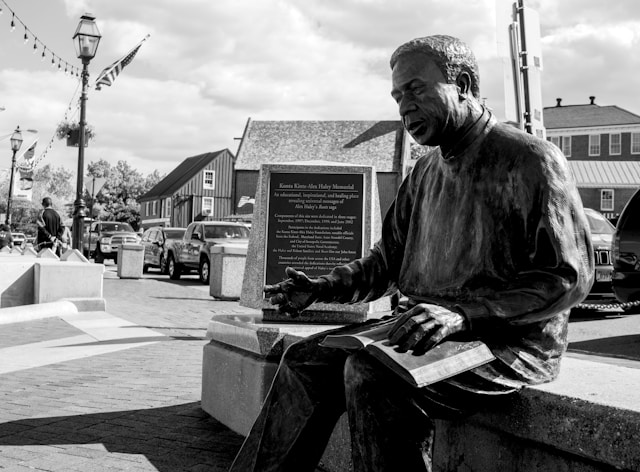
I will never forget watching Kunta Kinte in the 1977 TV miniseries, “Roots,” fighting to keep his name as an overseer’s whip came down again and again.
His determination was a brutal reminder of how white settlers used language to transform Black people into commodities: bought, sold, shipped and stripped of their identities. From “Roots,” I witnessed how slavery was designed to remove Black people’s humanity and brand them as products.
That memory resurfaced over Easter when President Donald Trump issued a a holiday message calling immigrants murderers, drug lords, dangerous prisoners, mentally insane and wife beaters.
In one social media post, millions of people seeking safety and opportunity were transformed into a monolithic threat, each label systematically stripping away their humanity and reducing them to dangerous caricatures worthy of fear rather than constitutional protection.
This dehumanization crystallized in the case of Kilmar Abrego Garcia, who was deported by the U.S. government in what officials admitted was as an “administrative error.” Salvadoran President Nayib Bukele declared during a meeting with Trump that he would not return Abrego Garcia to the United States despite a U.S. Supreme Court order.
Even as U.S. Sen. Chris Van Hollen, D-Md., met with Abrego Garcia in El Salvador, the Trump administration’s stance hasn’t changed. In fact, when questioned about the U.S. Supreme Court ruling, White House official Stephen Miller coldly stated: “He has no lawful right to be here. … It’s up to El Salvador what the fate of their own citizens is.”
In one breath, a human being with legal rights became a clerical mistake, then a foreign problem to be discarded.
As a literacy scholar, I know how words are strategically deployed to dehumanize. Studies show white settlers used words like heathen, brute and savage to justify enslavement. My own work, reveals how dehumanizing labels for Black women and girls directly lead to violence.
Continue reading Toliver’s piece.
Check out our exhibit, Nearly Three Centuries Of Enslavement.
Comments Are Welcome
Note: We moderate submissions in order to create a space for meaningful dialogue, a space where museum visitors – adults and youth –– can exchange informed, thoughtful, and relevant comments that add value to our exhibits.
Racial slurs, personal attacks, obscenity, profanity, and SHOUTING do not meet the above standard. Such comments are posted in the exhibit Hateful Speech. Commercial promotions, impersonations, and incoherent comments likewise fail to meet our goals, so will not be posted. Submissions longer than 120 words will be shortened.
See our full Comments Policy here.