Community collects soil in remembrance of 1930 lynching
Share
Explore Our Galleries









Breaking News!
Today's news and culture by Black and other reporters in the Black and mainstream media.
Ways to Support ABHM?
By Jaylan Miller, Chronical-Tribune
Community members gathered at the northeast corner of the Grant County Courthouse square Friday evening to remember the events that took place on Aug. 7, 1930.
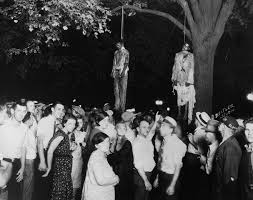
On the 90th anniversary of the infamous lynchings of Thomas Shipp and Abraham Smith, and the attempted lynching of James Cameron, members of the Marion Community Remembrance Project collected soil to be sent to the Equal Justice Initiative’s (EJI) National Memorial for Peace and Justice in Montgomery, Alabama.
“I think this year in particular with the murder of George Floyd, we’ve seen what happens when you have collective trauma, collective grief and collective action, and so I’m hoping from this moment we spark some new conversation, new action, and build our community in a different direction,” said organizer Torri Williams. “Tonight is just one step in the work that has already been done in the community.”
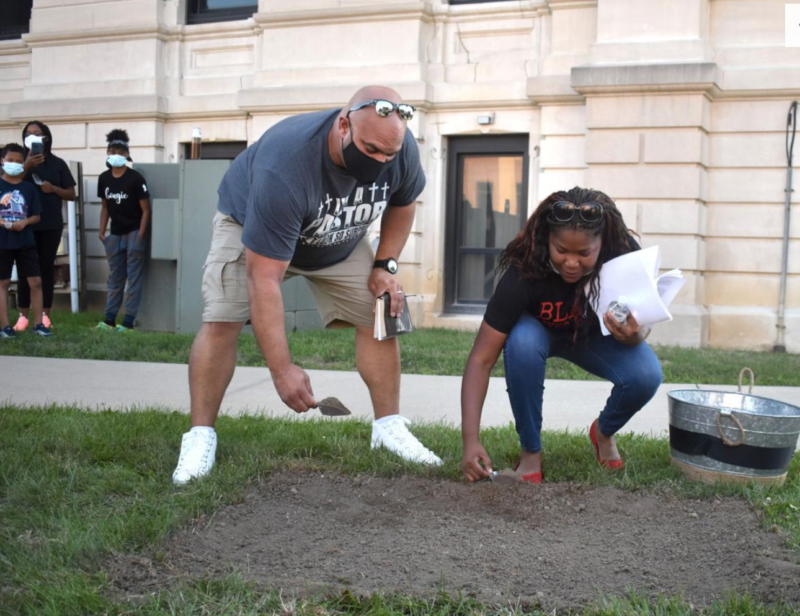
The Marion Community Remembrance Project is led by a coalition of local individuals, organizations and churches that desire reconciliation through the act of remembering.
On Friday morning, Pastor Andrew Morrell said he revisited pictures from his visit to the EJI National Memorial for Peace and Justice in 2016.
“I remember just looking at all of the dirt jars that were collected and just thinking of the fact that Marion is not here, why are we not here?” he said….
Some of the soil collected will be sent to the National Memorial for Peace and Justice at a later date, and a jar will be kept at the Marion Public Library Museum as well.
Williams said the coalition plans to host an essay contest for local high schoolers in partnership with EJI, as well as more community education events, facilitated discussions and workshops.
Read the full article here.
More about this lynching, ABHM’s founder who survived it, the world’s most famous lynching photo and the song “Strange Fruit”.
More Breaking News here.
Comments Are Welcome
Note: We moderate submissions in order to create a space for meaningful dialogue, a space where museum visitors – adults and youth –– can exchange informed, thoughtful, and relevant comments that add value to our exhibits.
Racial slurs, personal attacks, obscenity, profanity, and SHOUTING do not meet the above standard. Such comments are posted in the exhibit Hateful Speech. Commercial promotions, impersonations, and incoherent comments likewise fail to meet our goals, so will not be posted. Submissions longer than 120 words will be shortened.
See our full Comments Policy here.