Biden to Create Monument to Emmett Till Amid Fights Over Black History
Share
Explore Our Galleries









Breaking News!
Today's news and culture by Black and other reporters in the Black and mainstream media.
Ways to Support ABHM?
Erica L. Green, The New York Times
The murder of 14-year-old Emmett Till and the activism of his grieving mother helped galvanize the civil rights movement in America.
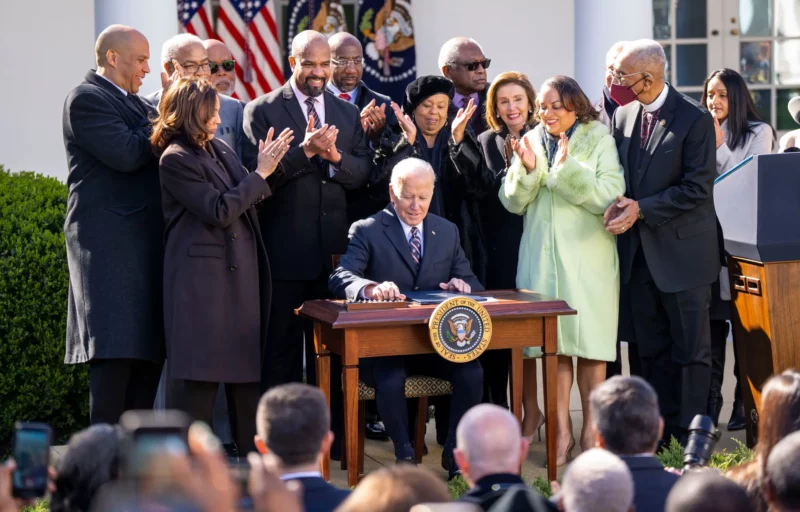
President Biden on Tuesday will establish a national monument honoring Emmett Till, the Black teenager who was abducted and killed by white supremacists in 1955, and his mother, Mamie Till-Mobley, who helped galvanize the civil rights movement by bravely displaying her child’s brutalized body for the world to see.
The Emmett Till and Mamie Till-Mobley National Monument will span three protected sites in Illinois, where Emmett was born 82 years ago, and in Mississippi, where he was killed at the age of 14 after being accused of whistling at a white woman.
The president’s decision to dedicate a monument to two figures whose story underscores the legacy of racism in America comes in the midst of a divisive political battle over how to teach Black history in schools.
Last week, Gov. Ron DeSantis of Florida, who is campaigning for the Republican presidential nomination, came under fire after education officials in his state introduced new standards for teaching Black history.
The standards say that middle schoolers should be instructed that “slaves developed skills which, in some instances, could be applied for their personal benefit.” The depiction drew widespread rebuke, including from Vice President Kamala Harris. […]
Since Mr. Biden took office, more than 40 states have introduced or passed laws or taken other measures to restrict how issues of race and racism are taught, according to Education Week. The outlet has been tracking the legislation against so-called “critical race theory,” a term that has been adopted by conservative activists as a catchall for teachings about race.
Karine Jean-Pierre, the White House press secretary, referenced Florida’s new standards on Monday, saying the Till monument was arriving “at an important moment.”
Read more about the purpose and importance of the monument in the original article.
Learn about three more victims who suffered fates similar to Emmett Till’s in this virtual exhibit. [Trigger warning: graphic images]
Find more Breaking News here.
Comments Are Welcome
Note: We moderate submissions in order to create a space for meaningful dialogue, a space where museum visitors – adults and youth –– can exchange informed, thoughtful, and relevant comments that add value to our exhibits.
Racial slurs, personal attacks, obscenity, profanity, and SHOUTING do not meet the above standard. Such comments are posted in the exhibit Hateful Speech. Commercial promotions, impersonations, and incoherent comments likewise fail to meet our goals, so will not be posted. Submissions longer than 120 words will be shortened.
See our full Comments Policy here.