Amanda Morgan Becomes First Black Woman Soloist For The Pacific Northwest Ballet
Share
Explore Our Galleries









Breaking News!
Today's news and culture by Black and other reporters in the Black and mainstream media.
Ways to Support ABHM?
By Aaron Allen, The Seattle Medium
Tacoma, Washington-based dancer Amanda Morgan was recently named soloist for the Pacific Northwest Ballet.
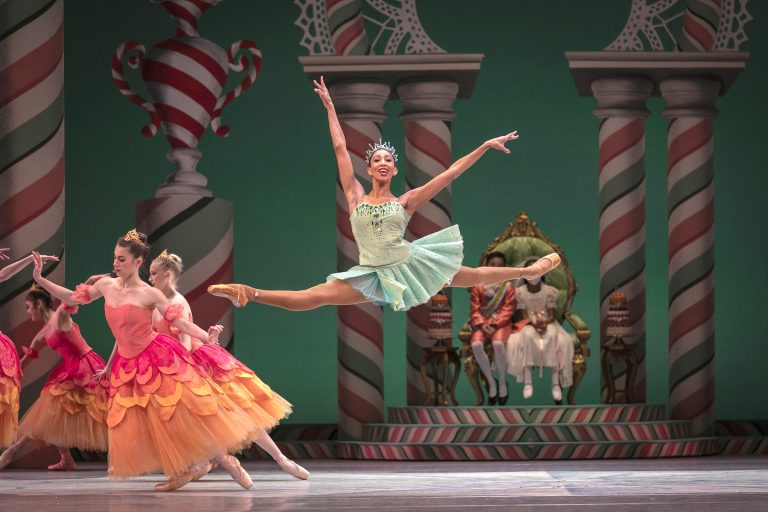
The Pacific Northwest Ballet (PNB) continues to provide opportunities for Black people to excel and hold prominent positions in the company. During the last twelve months, PNB had two African American girls play the lead role in their signature holiday engagement – the Nutcracker last season, named their first Black principal male dancer in the history of the company, and recently named Tacoma native Amanda Morgan as a soloist in the company – making her the first Black woman in the history of PNB to do so.
In the hierarchy of ballet, being a soloist is the steppingstone to becoming a principal dancer — the highest rank and most prominent position within a professional dance company. In the professional division, a ballerina can advance her or his career by years of dedication and work as one moves up the latter from apprentice, to being in the “corps de ballet”, to becoming a soloist and then a principal.
According to Morgan, being promoted to a soloist is a dream come true, and an accomplishment that she does not take for granted. While she has had her fair share of trials, tribulations and setbacks over the years, Morgan says that it is important for young Black girls and boys to have someone that they can identify with in the industry, and to show them, by example, that there is a place for them in ballet – something that was not available to Morgan as she worked her way through the ranks.
“The most challenging thing [for me navigating the industry was] being the only Black woman in the company for so long and also not having [a Black woman] in the company for so long, even when I was a student,” says Morgan. “When I first joined [the company] I felt an enormous amount of pressure to not only do good for myself because I wanted to be good, but I also felt like I needed to be just as good, if not better than everyone else to prove that I belong here because I was different.”
The Seattle Medium covers the challenge to become a successful dancer.
Black women like Solange Knowles are also taking on opportunities to compose ballets.
Comments Are Welcome
Note: We moderate submissions in order to create a space for meaningful dialogue, a space where museum visitors – adults and youth –– can exchange informed, thoughtful, and relevant comments that add value to our exhibits.
Racial slurs, personal attacks, obscenity, profanity, and SHOUTING do not meet the above standard. Such comments are posted in the exhibit Hateful Speech. Commercial promotions, impersonations, and incoherent comments likewise fail to meet our goals, so will not be posted. Submissions longer than 120 words will be shortened.
See our full Comments Policy here.