Solange Enters New Territory: Ballet Composer
Share
Explore Our Galleries









Breaking News!
Today's news and culture by Black and other reporters in the Black and mainstream media.
Ways to Support ABHM?
By Joshua Barone, New York Times
The multihyphenate pop star will compose her first ballet score for the Fall Fashion Gala at New York City Ballet in September.
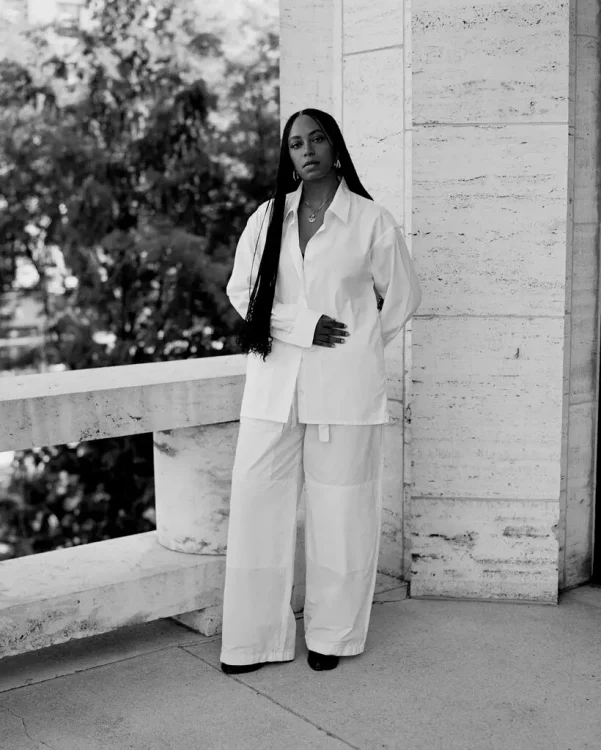
Solange, the pop star whose artistic tendrils have reached into the worlds of music, choreography, fashion, film, visual art and more, will soon add a new genre to her repertoire: ballet composer.
New York City Ballet announced on Monday that Solange would write an original score for a work (as yet untitled) by Gianna Reisen that will premiere at the company’s annual Fall Fashion Gala, on Sept. 28. The score is composed for a chamber ensemble that will be made up of some of Solange’s musical collaborators and members of the City Ballet orchestra.
This step into ballet is the latest in a series of adventurous turns by Solange, 36, who began her career young as a singer and dancer — including with her sister, Beyoncé, in Destiny’s Child. Solange’s work later blossomed into multihyphenate and more independent territory, with her music — starting with the 2012 album “True” and continuing with “A Seat at the Table” (2016) and “When I Get Home” (2019) — often doubling as a gathering place for genre-crossing, interdisciplinary artists. In her art and in the streets, she has also been an activist for Black Lives Matter and other causes.
Solange has long had a theatrical edge that brought her into contact with Lincoln Center regulars and collaborators beyond the musical sphere. She has worked with the designer Carlos Soto, a regular partner of the auteurist director Robert Wilson, and organized programming — as well as brought her own performances — to spaces like the Guggenheim and Getty museums, as well as the Chinati Foundation in Marfa, Texas, and the Elbphilharmonie in Hamburg, Germany.
Her music for Reisen will be her debut in ballet, which was formative for her as a child in Houston. She saw Lauren Anderson, a pioneering Black principal dancer at Houston Ballet, and once told the writer Ayana Mathis, “My dream was to go to Juilliard.”
Finish the article on NYT.
Meanwhile, Knowles’ sister Beyonce has recently released an album.
Find more articles this like in ABHM’s breaking news section.
Comments Are Welcome
Note: We moderate submissions in order to create a space for meaningful dialogue, a space where museum visitors – adults and youth –– can exchange informed, thoughtful, and relevant comments that add value to our exhibits.
Racial slurs, personal attacks, obscenity, profanity, and SHOUTING do not meet the above standard. Such comments are posted in the exhibit Hateful Speech. Commercial promotions, impersonations, and incoherent comments likewise fail to meet our goals, so will not be posted. Submissions longer than 120 words will be shortened.
See our full Comments Policy here.