Abolitionists Rescue Fugitive Slave from Boston Courtroom

Share

Explore Our Galleries

An NAACP flyer campaigning for the Dyer Anti-Lynching Bill, which passed the U.S. House of Representatives in 1922, but was filibustered to defeat in the Senate. Dyer, the NAACP, and freedom fighters around the country, like Flossie Baily, struggled for years to get the Dyer and other anti-lynching bills passed, to no avail. Today there is still no U.S. law specifically against lynching. In 2005, eighty of the 100 U.S. Senators voted for a resolution to apologize to victims' families and the country for their failure to outlaw lynching. Courtesy of the National Association for the Advancement of Colored People (NAACP).
Some Exhibits to Come – One Hundred Years of Jim Crow
Mammy Statue JC Museum Ferris
Bibliography – One Hundred Years Of Jim Crow
Claude, age 23, just months before his 1930 murder. Courtesy of Faith Deeter.
Freedom’s Heroes During Jim Crow: Flossie Bailey and the Deeters
Souvenir Portrait of the Lynching of Abram Smith and Thomas Shipp, August 7, 1930, by studio photographer Lawrence Beitler. Courtesy of the Indiana Hisorical Society.
An Iconic Lynching in the North
Lynching Quilt
Claxton Dekle – Prosperous Farmer, Husband & Father of Two
Ancient manuscripts about mathematics and astronomy from Timbuktu, Mali
Some Exhibits to Come – African Peoples Before Captivity
Shackles for Adults & Children from the Henrietta Marie
Some Exhibits to Come – The Middle Passage
Slaveship Stowage Plan
What I Saw Aboard a Slave Ship in 1829
Arno Michaels
Life After Hate: A Former White Power Leader Redeems Himself

Breaking News!

Today's news and culture by Black and other reporters in the Black and mainstream media.

Ways to Support ABHM?

From the African American Registry
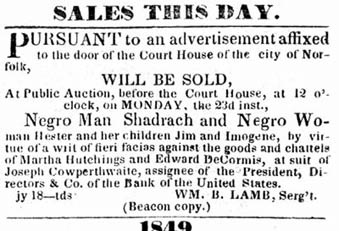
Advertisement of sheriff’s sale of Shadrach Minkins, 1849 Courtesy Gary Collison
Advertisement of sheriff’s sale of Shadrach Minkins, 1849
Courtesy Gary Collison

On this date 1851, Black [and white] abolitionists broke into a Boston courthouse and rescued Shadrach Minkins, a fugitive slave.

Born in Norfolk in 1800, Minkins was affected by the Nat Turner rebellion and the death of his owners Thomas and Ann Glenn.

Minkins escaped north to Boston Massachusetts in 1850. A year later working as a waiter serving breakfast at a coffeehouse in Boston history caught up with him. Arrested, he was the first runaway to be detained in New England under the 1850 Fugitive Slave Law. Minkins became a catalyst of one of the most dramatic episodes of rebellion and legal wrangling before the Civil War.
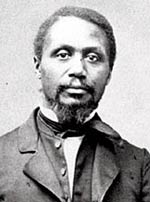
Attorney Robert Morris (1823–1882)  Recently admitted to the practice of law, Robert Morris served as one of the attorneys representing Shadrach Minkins. Morris was accused of opening the courtroom door to admit Shadrach’s rescuers and charged with treason for his action. After a jury trial, he was acquitted. Courtesy of the Social Law Library, Boston
Attorney Robert Morris

After his daring courthouse rescue he escaped to Canada and with other African American expatriates in Montreal created the city’s first Black community. Minkins died in 1875, without a country but a free man.

Read more about this incident and what happened to the abolitionist rescuers, here.

Learn about another abolitionist.

Read more Breaking News here.

Comments Are Welcome

Note: We moderate submissions in order to create a space for meaningful dialogue, a space where museum visitors – adults and youth –– can exchange informed, thoughtful, and relevant comments that add value to our exhibits.

Racial slurs, personal attacks, obscenity, profanity, and SHOUTING do not meet the above standard. Such comments are posted in the exhibit Hateful Speech. Commercial promotions, impersonations, and incoherent comments likewise fail to meet our goals, so will not be posted. Submissions longer than 120 words will be shortened.

See our full Comments Policy here.

Leave a Comment







