A Song Without Words
Share
Explore Our Galleries









Breaking News!
Today's news and culture by Black and other reporters in the Black and mainstream media.
Ways to Support ABHM?
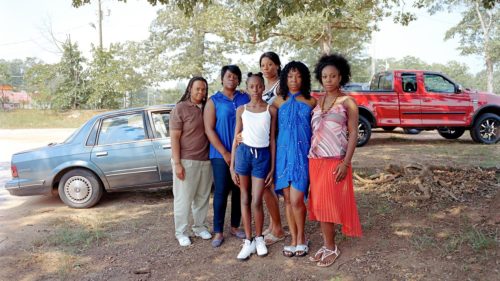
Photographs by Johnathon Kelso Moore’s Ford Bridge reenactors arrive at the First African Baptist Church in Monroe for the 13th annual reenactment of the Moore’s Ford Bridge lynchings. From left to right, Alesha Whitaker, Lisa Searcy-Williams, Brenda Washington and her daughter Jamilah Muhammad, Clinethia Chaney, and Kristina Nikol Cureton.
In 2017, photographer Johnathon Kelso began a project to test himself and his faith. This white Florida native decided to document lynching sites in six Southern states and to talk with the victims’ descendants. It was, Kelso says, a mission from God. And it is clearly one Southerner’s heartfelt attempt to extend his hand across a painful old divide.
by Tim Turner, The Bitter Southerner
A lifetime of white privilege allowed Johnathon Kelso to avoid difficult conversations about race. But his faith would not. His heart had ached too long, and his eyes had seen too much to remain silent.
So, beginning in the spring of 2017, the photographer began a series of visits to sites where lynchings happened in six Southern states. The resulting photos — a project he dubbed “A Song Without Words” — are modern-day mirrors of horrific acts of domestic terrorism visited upon black men, women, and children throughout the region with impunity from either police or pulpit.
Few want to talk honestly about Southerners’ moral nullity as relates to their treatment of blacks. But Kelso hopes these images will help stimulate authentic conversations among the races. Being honest about race and the ugly history of lynching in the South represents spiritual growth for the Atlanta-based Kelso. He’s a Christian, which led him to examine himself on a far more personal level than he’d ever dared, which led us both to the foyer of his church in Decatur, Georgia…
“That’s something that’s wrong with the church,” Kelso said. “Church with a Big C. You’ve heard it said that 11 a.m. Sunday is the most segregated hour. That’s a problem. That’s a big problem.” When Trinity Anglican Mission took up the issue, congregants were shown a clip from a talk by Bryan Stevenson, the founder and executive director of the Alabama-based Equal Justice Initiative and the driving force behind the recently opened National Memorial for Peace and Justice in Montgomery.
Stevenson’s words resonated with Kelso…
“My worldview, whether I like it or not, has been seen through the lens of people with white skin like mine,” Kelso said. “And my perspective has been constrained to the comfortable ease of the mirror rather than to the difficulty of diversity.
“If this project has prescribed any remedy for such a sin sickness, it has been that of repentance and sorrow for how practically idealistic I’ve viewed my own race and religion. After all, it was the white church of the South that has permitted and condoned its own national pastime of crucifying black bodies with such unfeigned satisfaction. W.E.B Du Bois pointed at the truth when he said, ‘A nation’s religion is its life, and as such white Christianity is a miserable failure…’”
Read the full article here
Read more Breaking News here
More information on Emmett Till here
View more galleries from the ABHM here
Comments Are Welcome
Note: We moderate submissions in order to create a space for meaningful dialogue, a space where museum visitors – adults and youth –– can exchange informed, thoughtful, and relevant comments that add value to our exhibits.
Racial slurs, personal attacks, obscenity, profanity, and SHOUTING do not meet the above standard. Such comments are posted in the exhibit Hateful Speech. Commercial promotions, impersonations, and incoherent comments likewise fail to meet our goals, so will not be posted. Submissions longer than 120 words will be shortened.
See our full Comments Policy here.