A Mecca for Black History Turns 100
Share
Explore Our Galleries









Breaking News!
Today's news and culture by Black and other reporters in the Black and mainstream media.
Ways to Support ABHM?
By Jennifer Schuessler, New York Times
The New York Public Library’s Schomburg Center celebrates its beginnings, at a moment when Black history is under attack.
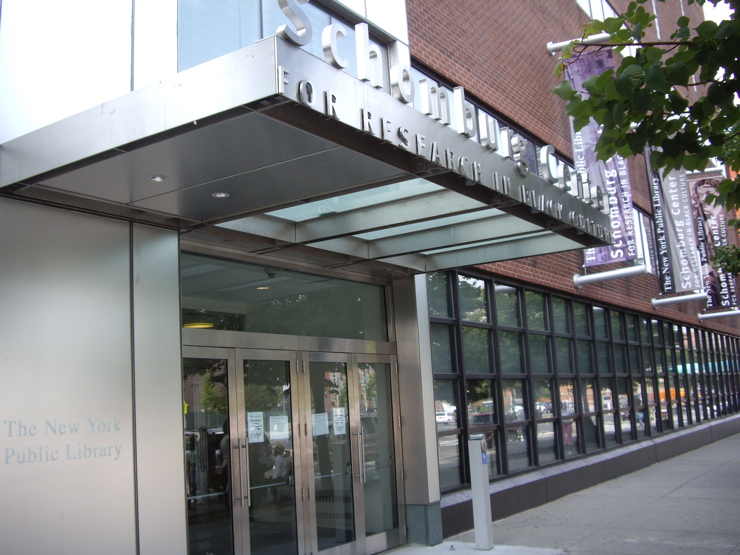

Even on an ordinary day, walking into the New York Public Library’s Schomburg Center for Research in Black Culture in Harlem can feel like walking into a shrine.
The ashes of the poet Langston Hughes are buried under the lobby floor, and its reading rooms hold one of the world’s leading collections of material relating to the African diaspora — more than 11 million items.
But on a morning last month, the vibe was more joyful noise than hush. When the doors opened, a group of African drummers led a procession of several hundred people into the lobby, where the Rev. Nafisa Sharriff, an interfaith minister, stood on the mosaic of the cosmos inspired by one of Hughes’s poems to deliver a blessing.
ImageThe Schomburg Center inaugurated a yearlong centennial celebration in May, with a ceremony in the lobby, where the ashes of the poet Langston Hughes are interred under a mosaic of the cosmos.Credit…Isseu Diouf Campbell
It was 100 years to the day since the Schomburg’s forerunner, the Division of Negro Literature, History and Prints, opened. And it was the kickoff to a year of celebrations, which continue this Saturday with the Schomburg Centennial Festival, a day of literary and cultural events, culminating with an outdoor block party featuring a performance by Slick Rick.
It’s a celebratory moment for the Schomburg, but also a fraught one. In recent months, the Trump administration has slashed federal funding for libraries, museums and humanities scholarship as part of a pivot toward what the president is calling patriotic history. And his broadsides against diversity, equity and inclusion efforts — along with more targeted attacks on the Smithsonian’s National Museum of African American History and Culture — have left many Black institutions feeling both defiant and deeply uncertain.
You can learn about Black history from anywhere in the world with our digital exhibits.
Comments Are Welcome
Note: We moderate submissions in order to create a space for meaningful dialogue, a space where museum visitors – adults and youth –– can exchange informed, thoughtful, and relevant comments that add value to our exhibits.
Racial slurs, personal attacks, obscenity, profanity, and SHOUTING do not meet the above standard. Such comments are posted in the exhibit Hateful Speech. Commercial promotions, impersonations, and incoherent comments likewise fail to meet our goals, so will not be posted. Submissions longer than 120 words will be shortened.
See our full Comments Policy here.