At the Roosevelt Library, an Unflinching Look at Race
Share
Explore Our Galleries









Breaking News!
Today's news and culture by Black and other reporters in the Black and mainstream media.
Ways to Support ABHM?
By Jennifer Schuessler, The New York Times
A new exhibition at the Franklin D. Roosevelt Presidential Library explores the president’s “mixed” record on civil rights — and the charged debate over racism in the New Deal.
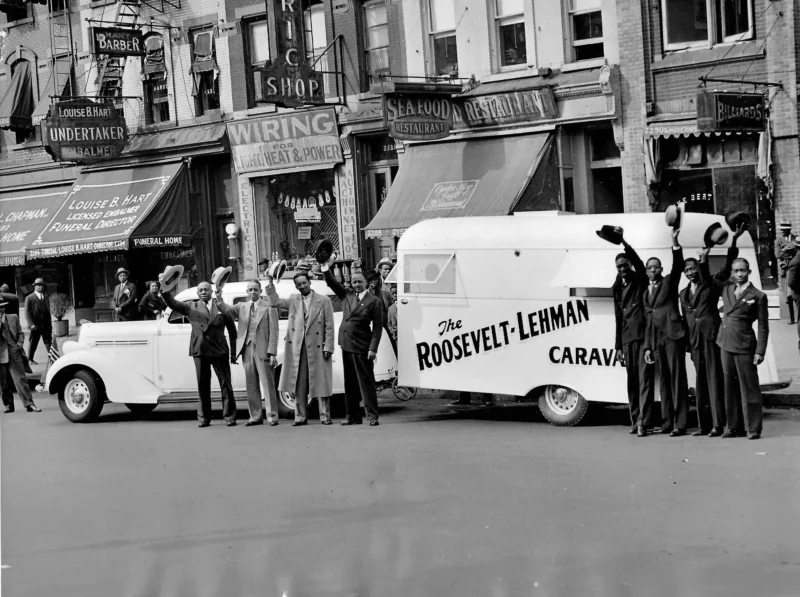
In October 1935, President Franklin D. Roosevelt had his administration send letters to thousands of clergy across the country, asking if the New Deal was helping their communities.
Even from admirers, the news wasn’t always good. Local administrators did not “carry out your will and purpose,” J.H. Ellis, a Black pastor in Hot Springs, Ark., wrote, “especially as it relates to the Negro group.” J.W. Hairston, an African American minister in Asheville, N.C., lamented that in the South “there are two states and two cities, one white — one black.”
The Northern Black press, meanwhile, was more blunt. The New Deal, more than one newspaper proclaimed, was also a “Raw Deal.”
Eight decades later, that charge still hangs in the air. Conservatives have long assailed the New Deal, which radically expanded the government’s involvement in the economy, as the epitome of big-government overreach. But in recent years, progressives have increasingly argued that this pillar of 20th-century liberalism rested on a Jim Crow foundation, and laid the groundwork for the yawning Black wealth gap that persists today.
Now, the Franklin D. Roosevelt Presidential Library and Museum in Hyde Park, N.Y., is entering the fray. “Black Americans, Civil Rights and the Roosevelts, 1932-1962,” on view through December 2024, takes a frank, deeply researched view of what it calls Franklin and Eleanor Roosevelt’s “mixed” record on race, from their personal attitudes to the policies they championed. But the exhibition just as much about the Black Americans — civil rights leaders and ordinary citizens alike — who pushed them, and American democracy, on true equality.
William A. Harris, the library’s director, called it part of a “paradigm shift” in the approach toward presidential history.
“Presidential libraries aren’t just about the name on the building,” he said. “They have to tell the story of everybody.”
Read more about the library and its new exhibit in the original article.
Learn more about Jim Crow and its lasting effects on the Black community in this virtual exhibit.
Find more Breaking News here.
Comments Are Welcome
Note: We moderate submissions in order to create a space for meaningful dialogue, a space where museum visitors – adults and youth –– can exchange informed, thoughtful, and relevant comments that add value to our exhibits.
Racial slurs, personal attacks, obscenity, profanity, and SHOUTING do not meet the above standard. Such comments are posted in the exhibit Hateful Speech. Commercial promotions, impersonations, and incoherent comments likewise fail to meet our goals, so will not be posted. Submissions longer than 120 words will be shortened.
See our full Comments Policy here.