How Decades of Racist Housing Policy Left Neighborhoods Sweltering
Share
Explore Our Galleries









Breaking News!
Today's news and culture by Black and other reporters in the Black and mainstream media.
Ways to Support ABHM?
By, , New York Times
In the 1930s, federal officials redlined these neighborhoods in Richmond, Va., marking them as risky investments because residents were Black.
Today, they are some of the hottest parts of town in the summer, with few trees and an abundance of heat-trapping pavement.
White neighborhoods that weren’t redlined tend to be much cooler today — a pattern that repeats nationwide.
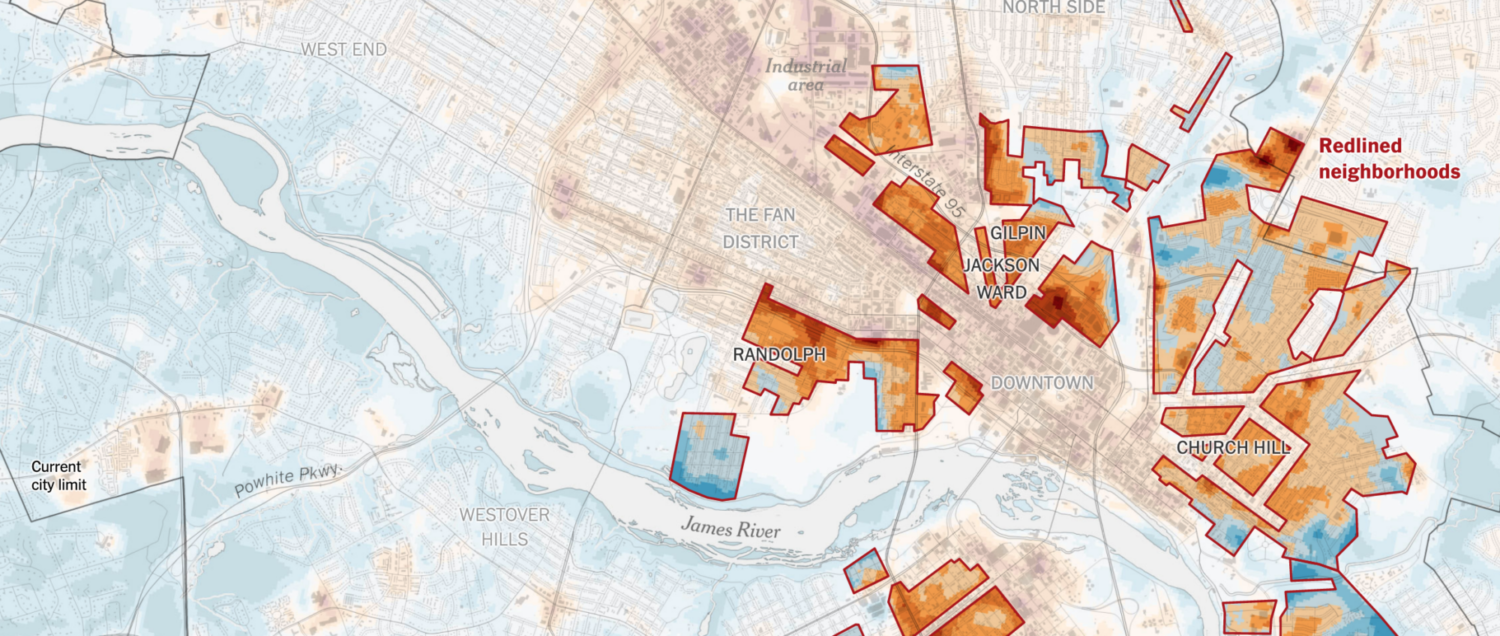
RICHMOND, Va. — On a hot summer’s day, the neighborhood of Gilpin quickly becomes one of the most sweltering parts of Richmond.
There are few trees along the sidewalks to shield people from the sun’s relentless glare. More than 2,000 residents, mostly Black, live in low-income public housing that lacks central air conditioning. Many front yards are paved with concrete, which absorbs and traps heat. The ZIP code has among the highest rates of heat-related ambulance calls in the city.
There are places like Gilpin all across the United States. In cities like Baltimore, Dallas, Denver, Miami, Portland and New York, neighborhoods that are poorer and have more residents of color can be 5 to 20 degrees Fahrenheit hotter in summer than wealthier, whiter parts of the same city.
And there’s growing evidence that this is no coincidence. In the 20th century, local and federal officials, usually white, enacted policies that reinforced racial segregation in cities and diverted investment away from minority neighborhoods in ways that created large disparities in the urban heat environment.
The consequences are being felt today.
See the interactive map and read the full article here.
Read about the history of redlining and the impacts of segregation here.
More Breaking News here.
Comments Are Welcome
Note: We moderate submissions in order to create a space for meaningful dialogue, a space where museum visitors – adults and youth –– can exchange informed, thoughtful, and relevant comments that add value to our exhibits.
Racial slurs, personal attacks, obscenity, profanity, and SHOUTING do not meet the above standard. Such comments are posted in the exhibit Hateful Speech. Commercial promotions, impersonations, and incoherent comments likewise fail to meet our goals, so will not be posted. Submissions longer than 120 words will be shortened.
See our full Comments Policy here.