Why Do We Still Care About the Confederate Flag?
Share
Explore Our Galleries









Breaking News!
Today's news and culture by Black and other reporters in the Black and mainstream media.
Ways to Support ABHM?
By Hanna Kozlowska, The New York Times
[…]
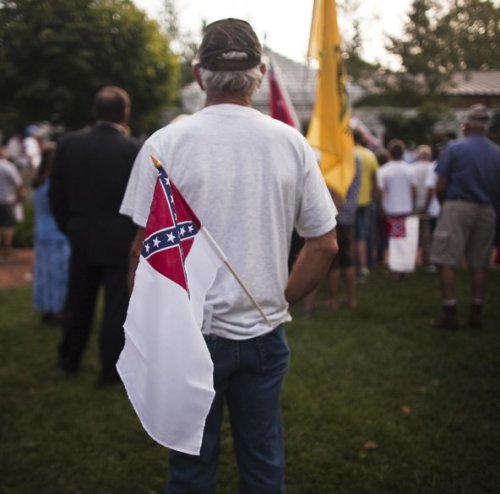
Nearly 150 years after the Civil War ended, the Confederate flag is still one of the nation’s most divisive emblems. Many a Yankee will attest to the shock and horror they feel upon seeing the multitude of Confederate flags when they first arrive in the South. For them, it’s a symbol of slavery, of oppression and systemic racism. But many Southerners see it as a point of local pride and a celebration of their heritage, putting the flag on their bumper stickers and on their lawns.
But when that lawn belongs to a government institution, the flag becomes a political problem.
South Carolina’s Republican Gov. Nikki Haley recently got herself into hot water when she defended the flag standing on the grounds of the South Carolina State House. While she acknowledged that it was a sensitive issue, she also underlined that over the course of her term and many phone conversations with chief executives, she did not have “one conversation with a single C.E.O. about the Confederate flag.” She also said that South Carolina’s image problem was “fixed” with her election, as an Indian-American, and with the appointment of an African-American Senator, Tim Scott.
The MSNBC host Melissa Harris-Perry wrote a letter to Governor Haley, defining herself as a “Southern girl” who grew up surrounded by the Confederate flag. She says that black Americans are, by and large, Southerners, that their history is “deeply intertwined with Southern history,” that their experience includes slavery and Jim Crow but also “church picnics, HBCU football games and jazz music.” As black Southerners, Ms. Harris-Perry writes, “we have a complicated relationship to the ’ol stars and bars. We rarely paint it on our pick-ups but we do not automatically flinch and recoil when we see it.”
But, she says, Ms. Haley is not just a Southerner, she is “a duly elected governor in the United States of America.” Displaying the Confederate flag on state-owned grounds suggests “honor upon an act of treason,” she says. “To remember that we are one nation-indivisible — we fly the flag of our union.”…
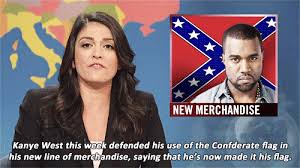
Some say that the entire debate over the Confederate flag is pointless. Writing several weeks after the shooting of Michael Brown in Ferguson, Mo., John McWhorter said at The Daily Beastthat we should focus our energies elsewhere. “A serious approach to racism in this country will be about black men and the police,” Mr. McWhorter writes. The discussion is a “futile endeavor” because of the various meanings assigned to the flag and because of the fact that in the absence of the Confederate flag, the racist constituency would just choose a different symbol.
Read the full article here.
Read more Breaking News here.
Comments Are Welcome
Note: We moderate submissions in order to create a space for meaningful dialogue, a space where museum visitors – adults and youth –– can exchange informed, thoughtful, and relevant comments that add value to our exhibits.
Racial slurs, personal attacks, obscenity, profanity, and SHOUTING do not meet the above standard. Such comments are posted in the exhibit Hateful Speech. Commercial promotions, impersonations, and incoherent comments likewise fail to meet our goals, so will not be posted. Submissions longer than 120 words will be shortened.
See our full Comments Policy here.