What Was The Black Christmas Boycott Of 1963?
Share
Explore Our Galleries









Breaking News!
Today's news and culture by Black and other reporters in the Black and mainstream media.
Ways to Support ABHM?
By Bilal G. Morris, NewsOne
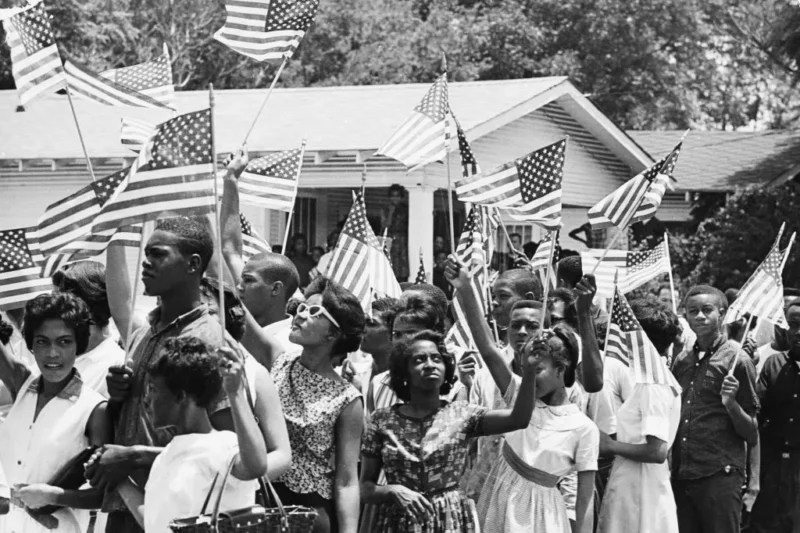
During the winter of 1963, while America celebrated the holidays, Black people in Greenville, North Carolina, decided to take action, challenge the status quo and demand change. This was the birth of the Black Christmas Boycott of 1963, also known as the Christmas Sacrifice.
The Black Christmas Boycott of 1963 was a pivotal and powerful movement during the Civil Rights Era. It was a true expression of dissent against Jim Crow laws, which perpetuated racial segregation and inequality.
While white America was singing joyous melodies and enjoying everything that comes with the holiday season, Black activists were mobilizing during the months of November and December of 1963. Off the heels of the 1960 Montgomery bus boycotts, activists like Dr. Martin Luther King Jr. and Medgar Evers encouraged Black protesters and citizens to join the nonviolent protest and abstain from Christmas shopping. Two years earlier, the Student Nonviolent Coordinating Committee organized a national Christmas boycott against any store that enforced Jim Crow laws.
Medgar Evers, the first field officer for Jackson, Mississippi’s branch of the NAACP, was on the frontlines of the 1960 boycott, which was directed at local stores to promote desegregation and civil rights. The boycott lasted from early December of 1962 to early 1963.
In 1963, calls were renewed to boycott Christmas following the assassination of Medgar Evers, JFK, the 16th Street Baptist Church bombing, as well as other violent instances centered around racism. Six Black children were killed that year, including teenage girls—Addie Mae Collins, Denise McNair, Carole Robertson, and Cynthia Wesley, who were murdered when the KKK bombed Birmingham’s 16th Street Baptist Church.
In September of that year, Black American writer and activist James Baldwin spoke at the New York Community Church and called for a “massive civil disobedience campaign” and encouraged not just Black people, but all Americans to use their economic power and boycott. Although the campaign didn’t have a ton of success, it began to bring attention to the boycotts and what they stood for.
By the end of 1963, the city of Greenville, North Carolina, held a demonstration that would be known as the “Christmas Sacrifice,” which was a boycott inspired by Evers, King Jr. and the hard work of the Student Nonviolent Coordinating Committee. The demonstration, which the Progressive Citizens Council set up, was initially meant to boycott downtown businesses, then expanded into a blackout of Christmas tree lights, which brought more awareness to the cause.
“The blackout was very successful…the experience gave the Negro a sense of unity that he has generally lacked,” said North Carolina mayor’s co-operating committee.
According to reports, only six Black families in Greenville had Christmas tree lights up during Christmas. The next year, Grenville, whose Black population was more than a third of the total population, saw the largest increase in hiring of black employees for the Christmas season the city had ever seen.
As we remember the Black Christmas Boycott and its impact on the Civil Rights Movement, let us never forget the people who put their lives on the line to make America just a little bit better for Black people.
See the original article here.
The 20th century has spawned some of most influential movements for justice and equal rights, visit our exhibit I Am Somebody! The Struggle for Justice to learn more.
Read more Breaking News.
Comments Are Welcome
Note: We moderate submissions in order to create a space for meaningful dialogue, a space where museum visitors – adults and youth –– can exchange informed, thoughtful, and relevant comments that add value to our exhibits.
Racial slurs, personal attacks, obscenity, profanity, and SHOUTING do not meet the above standard. Such comments are posted in the exhibit Hateful Speech. Commercial promotions, impersonations, and incoherent comments likewise fail to meet our goals, so will not be posted. Submissions longer than 120 words will be shortened.
See our full Comments Policy here.