What does it mean to be Black enough? Cord Jefferson explores this ‘American Fiction.’
Share
Explore Our Galleries









Breaking News!
Today's news and culture by Black and other reporters in the Black and mainstream media.
Ways to Support ABHM?
Tonya Mosley, Fresh Air
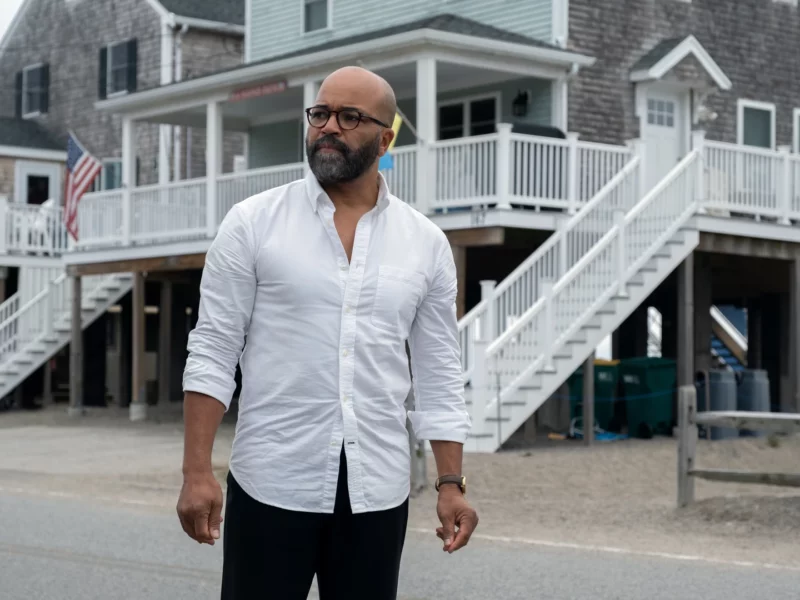
In the satirical film American Fiction, a frustrated writer named Thelonious “Monk” Ellison (played by Jeffrey Wright) can’t get his latest book published because editors say it’s not “Black” enough. Monk’s editors want clichéd stories about Black life — something screenwriter and director Cord Jefferson says he experienced first-hand as a writer in Hollywood.
“People would call me and they would say, ‘Do you want to write this TV show about a Black teenager murdered by the police? Do you want to write about this movie about a slave? Do you want to write this movie about crack dealers?'” Jefferson says. “It just felt like there’s still just such a hugely limited perspective as to what Black life looks like.”
Jefferson got his start as a journalist before becoming a TV writer for Succession, The Good Placeand Watchmen, among others shows. American Fiction is based on Percival Everett’s 2001 novel, Erasure, which Jefferson says he “devoured” in 2020.
“It felt like it was a book written specifically for me,” he says. “About 50 pages in, I knew that I wanted to try to adapt the script. … About 100 pages, and I knew I wanted to adapt it and direct it.”
The film, which has been nominated for a Golden Globe for best comedy, follows along as Monk writes the kind of “Black” book the publishers want, using every tired and offensive trope he can think of. He submits the manuscript under a pseudonym, and, to his surprise, is offered a $1 million book deal.
Jefferson says using satire to tackle racism was both fun and cathartic: “You’re talking about these serious issues, but you’re talking about them in a way that makes you laugh … [and] makes other people laugh,” he says. “I think that there’s a power in that that other kinds of art don’t have.”
Read the highlights of the interview with Jefferson on Radio Milwaukee, or listen to the full interview on Fresh Air.
In recent years there have been many more films about the Black experience that have also been directed by Black directors. Click here to read another story about Black film.
Comments Are Welcome
Note: We moderate submissions in order to create a space for meaningful dialogue, a space where museum visitors – adults and youth –– can exchange informed, thoughtful, and relevant comments that add value to our exhibits.
Racial slurs, personal attacks, obscenity, profanity, and SHOUTING do not meet the above standard. Such comments are posted in the exhibit Hateful Speech. Commercial promotions, impersonations, and incoherent comments likewise fail to meet our goals, so will not be posted. Submissions longer than 120 words will be shortened.
See our full Comments Policy here.