U.S. Postal Service announces stamp honoring late Rep. John Lewis
Share
Explore Our Galleries









Breaking News!
Today's news and culture by Black and other reporters in the Black and mainstream media.
Ways to Support ABHM?
By Dareh Gregorian, NBC News
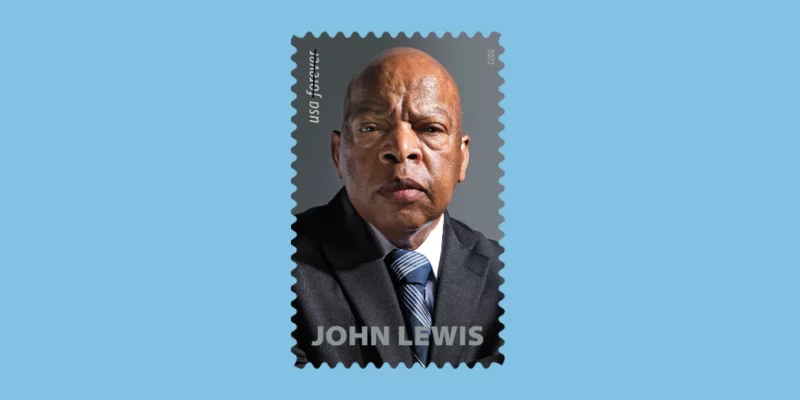
The U.S. Postal Service announced Tuesday it would memorialize the late Rep. John Lewis with a new stamp next year.
In its announcement, the Postal Service said the stamp “celebrates the life and legacy” of Lewis.
“Devoted to equality and justice for all Americans, Lewis spent more than 30 years in Congress steadfastly defending and building on key civil rights gains that he had helped achieve in the 1960s. Even in the face of hatred and violence, as well as some 45 arrests, Lewis remained resolute in his commitment to what he liked to call ‘good trouble,'” the Postal Service said.
Lewis, a giant of the civil rights movement who represented Georgia in Congress for decades, died of pancreatic cancer in July 2020. He was 80.
[…]
Lewis credited King and Rosa Parks for motivating him to stand up against segregation and inequality.
“I would ask my mother and my father and my grandparents, my great grandparents, ‘Why?’ And they would say: ‘That’s the way it is. Don’t get in the way. Don’t get in trouble,’” he recalled in a 2015 speech. “The action of Rosa Parks and the leadership of Martin Luther King Jr. inspired me to find a way to get in the way, to get in trouble — good trouble, necessary trouble.”
Lewis was also honored with a eulogy by President Obama and inspired BLM activists.
Comments Are Welcome
Note: We moderate submissions in order to create a space for meaningful dialogue, a space where museum visitors – adults and youth –– can exchange informed, thoughtful, and relevant comments that add value to our exhibits.
Racial slurs, personal attacks, obscenity, profanity, and SHOUTING do not meet the above standard. Such comments are posted in the exhibit Hateful Speech. Commercial promotions, impersonations, and incoherent comments likewise fail to meet our goals, so will not be posted. Submissions longer than 120 words will be shortened.
See our full Comments Policy here.