Tulsa’s new Black mayor proposes $100M trust to ‘repair’ impact of 1921 Race Massacre
Share
Explore Our Galleries









Breaking News!
Today's news and culture by Black and other reporters in the Black and mainstream media.
Ways to Support ABHM?
By SEAN MURPHY, Associated Press
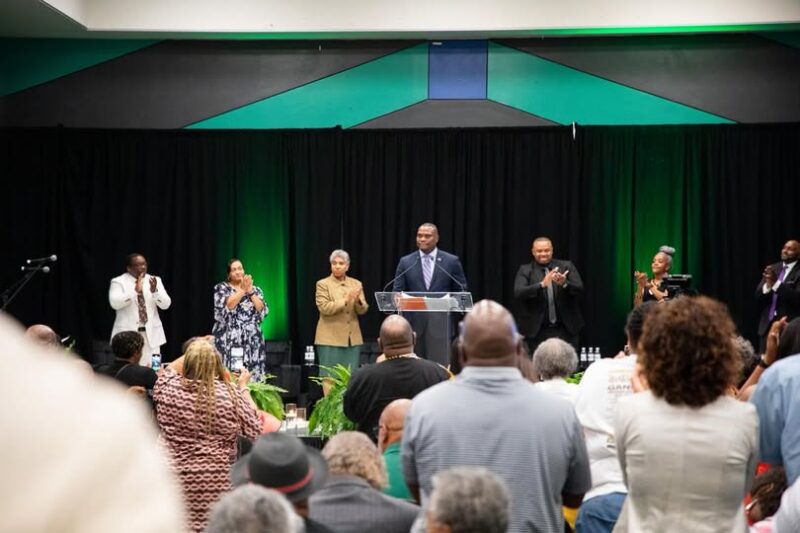
TULSA, Okla. (AP) — Tulsa’s new mayor on Sunday proposed a $100 million private trust as part of a reparations plan to give descendants of the 1921 Tulsa Race Massacre scholarships and housing help in a city-backed bid to make amends for one of the worst racial attacks in U.S. history.
The plan by Mayor Monroe Nichols, the first Black mayor of Oklahoma’s second-largest city, would not provide direct cash payments to descendants or the last two centenarian survivors of the attack that killed as many as 300 Black people. He made the announcement at the Greenwood Cultural Center, located in the once-thriving district that was destroyed by a white mob.
Nichols said he does not use the term reparations, which he calls politically charged, characterizing his sweeping plan instead as a “road to repair.”
“For 104 years, the Tulsa Race Massacre has been a stain on our city’s history,” Nichols said Sunday after receiving a standing ovation from several hundred people. “The massacre was hidden from history books, only to be followed by the intentional acts of redlining, a highway built to choke off economic vitality and the perpetual underinvestment of local, state and federal governments.
“Now it’s time to take the next big steps to restore.”
The AP has details about what it would take to make reparations happen in Tulsa. You can also see Mayor Nichols’ official statement.
Earlier this year, Nichols declared June 1st to be an observance day.
Comments Are Welcome
Note: We moderate submissions in order to create a space for meaningful dialogue, a space where museum visitors – adults and youth –– can exchange informed, thoughtful, and relevant comments that add value to our exhibits.
Racial slurs, personal attacks, obscenity, profanity, and SHOUTING do not meet the above standard. Such comments are posted in the exhibit Hateful Speech. Commercial promotions, impersonations, and incoherent comments likewise fail to meet our goals, so will not be posted. Submissions longer than 120 words will be shortened.
See our full Comments Policy here.