Tim Scott: The No. 2 Black Politician?
Share
Explore Our Galleries









Breaking News!
Today's news and culture by Black and other reporters in the Black and mainstream media.
Ways to Support ABHM?
By David Swerdlick, The Root
Now that the South Carolina congressman has been tapped to fill a U.S. Senate seat, he just might be.
[…]
As a senator, [Scott will] likely be called upon to be …more of an ambassador to voters of color from the Republican Party and for a farther-right worldview.
[…]
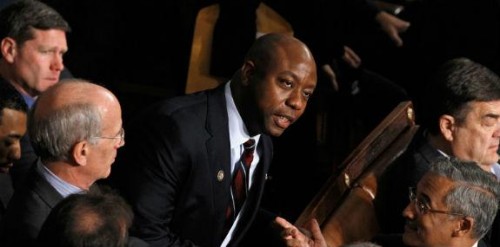
To do that effectively, however, he’ll have to find overlap between his view that “reducing the tax burden, decreasing government interference in the private sector and restoring fiscal responsibility” — themes that resonate among black, Latino and Asian-American voters — and some of the harsher stances that in recent years have put up a wall between the GOP and the voters it will need to win future national elections.
Like when Scott suggested last year that if Obama opted to sidestep Congress on raising the debt ceiling, he’d consider it “an impeachable act.” Or Scott’s 2011 proposal to deny food stamp eligibility for union members on strike — stances that fall squarely within today’s mainstream conservative thought but are generally nonstarters with black voters.
And ideologically, he’ll stand in contrast with the last black GOP senator, Massachusetts’ Ed Brooke, who was pro-choice, an advocate of the Fair Housing Act and arguably more liberal than Obama. It’s a contrast that underscores both the rightward drift of Republicans and the flight of black voters from the GOP over four decades.
Read more here.
Follow Scott’s career in our breaking news section.
Comments Are Welcome
Note: We moderate submissions in order to create a space for meaningful dialogue, a space where museum visitors – adults and youth –– can exchange informed, thoughtful, and relevant comments that add value to our exhibits.
Racial slurs, personal attacks, obscenity, profanity, and SHOUTING do not meet the above standard. Such comments are posted in the exhibit Hateful Speech. Commercial promotions, impersonations, and incoherent comments likewise fail to meet our goals, so will not be posted. Submissions longer than 120 words will be shortened.
See our full Comments Policy here.