This Day in History: America Elects Its First Black Governor
Share
Explore Our Galleries









Breaking News!
Today's news and culture by Black and other reporters in the Black and mainstream media.
Ways to Support ABHM?
From the African American Registry
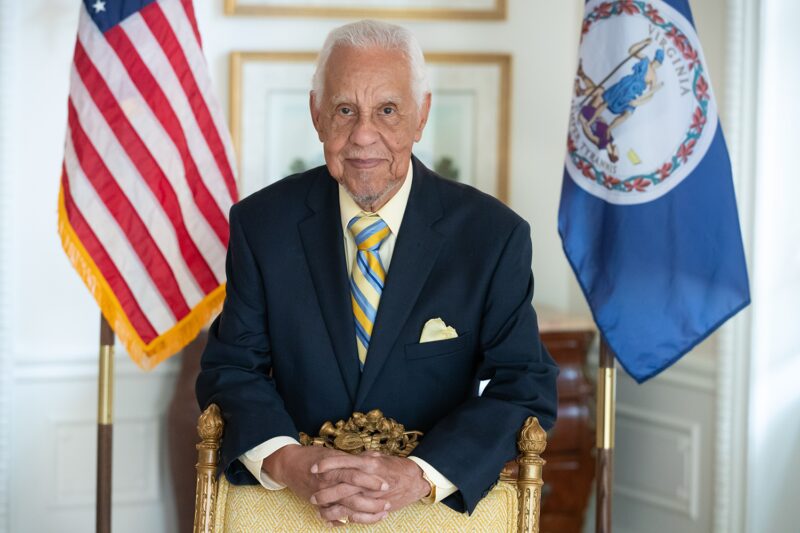
Lawrence Douglas Wilder was born in Richmond, Virginia, the seventh of eight children. The grandson of slaves, he was named after poet Paul Laurence Dunbar and abolitionist, speaker, and author Frederick Douglass. He attended segregated George Mason Elementary School, Armstrong High School, and Virginia Union University, where he graduated with a degree in chemistry in 1951.
Wilder then served in the Korean War, earning a Bronze Star. After his service in 1958, Wilder married Eunice Montgomery. Before divorcing in 1978, they had three children: Loren, Lynn, and Lawrence Douglas, Jr. He attended Howard University School of Law under the G.I. Bill, graduating in 1959 and co-founding the law firm Wilder, Gregory, and Associates.
Wilder began his political career after winning a 1969 special election to the Virginia Senate. He became the first African American state Senator from Virginia since Reconstruction. In 1985, still holding office in the state Senate, he was narrowly elected Lieutenant Governor of Virginia on a Democratic ticket under (then) Attorney General Gerald Baliles. Upon his election, Wilder became the first African American elected to statewide executive office in the South in the twentieth century.
Ascending from the office of Lieutenant Governor, Wilder succeeded Baliles in 1989. In 1990, in recognition of his landmark achievement, the NAACP awarded Wilder the Spingarn Medal. One of Wilder’s actions in office was to order schools and state agencies to divest investments in the country. He left the position after four years per the law.
Wilder returned to politics in 2004, when he won the first direct election for mayor in Richmond, Virginia. He served in that role for four years.
Learn more about Wilder.
Black politicians first served during Reconstruction.
More Black news.
Comments Are Welcome
Note: We moderate submissions in order to create a space for meaningful dialogue, a space where museum visitors – adults and youth –– can exchange informed, thoughtful, and relevant comments that add value to our exhibits.
Racial slurs, personal attacks, obscenity, profanity, and SHOUTING do not meet the above standard. Such comments are posted in the exhibit Hateful Speech. Commercial promotions, impersonations, and incoherent comments likewise fail to meet our goals, so will not be posted. Submissions longer than 120 words will be shortened.
See our full Comments Policy here.