This Day in Black History: Louis Farrakhan is Born
Share
Explore Our Galleries









Breaking News!
Today's news and culture by Black and other reporters in the Black and mainstream media.
Ways to Support ABHM?
The Encyclopedia of African-American Heritage by Susan Altman
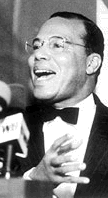
On this date in 1933, Louis Farrakhan was born. He is an African-American religious leader in the Muslim community.
In New York City, he was an outstanding student at Boston English High School and then attended Winston-Salem Teacher’s College. Farrakhan was an excellent musician; he played the violin and was a calypso singer. It was as a singer that he earned his livelihood before converting to Elijah Muhammad’s Nation of Islam in the 1950s. He quickly worked his way up to a leadership position, becoming the minister of the Boston mosque.
He loudly denounced Malcolm X after the latter split with Elijah Muhammad in 1963. He soon assumed leadership of the Harlem mosque, which Malcolm had previously led. After Elijah Muhammad’s death in 1975, he briefly supported Muhammad’s son and designated successor, Warith Muhammad, as leader of the Nation of Islam. Shortly after Warith Muhammad began accepting whites as members within the Nation of Islam, now renamed the World Community of Al-Islam in the West, Farrakhan split from him and established a rival organization with about 10,000 members.
Read more about Louis Farrakhan here.
Farrakhan spoke at a March on Washington anniversary event.
More notable events in Black history here.
Comments Are Welcome
Note: We moderate submissions in order to create a space for meaningful dialogue, a space where museum visitors – adults and youth –– can exchange informed, thoughtful, and relevant comments that add value to our exhibits.
Racial slurs, personal attacks, obscenity, profanity, and SHOUTING do not meet the above standard. Such comments are posted in the exhibit Hateful Speech. Commercial promotions, impersonations, and incoherent comments likewise fail to meet our goals, so will not be posted. Submissions longer than 120 words will be shortened.
See our full Comments Policy here.
… [Trackback]…
[…] Informations on that Topic: abhmuseum.org/2012/05/this-day-in-black-history-louis-farrakhan-is-born/ […]…