This Day in Black History: Jazz Singer Ella Fitzgerald is Born
Share
Explore Our Galleries









Breaking News!
Today's news and culture by Black and other reporters in the Black and mainstream media.
Ways to Support ABHM?
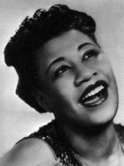
This date in 1918 marks the birth of Ella Fitzgerald. She was an African American jazz singer from Newport News, Virginia.
Considered one of the greatest singers in jazz history, Fitzgerald moved as a child with her mother and her stepfather to Yonkers, New York. As a teenager, she began winning amateur talent contests at the Harlem Opera House and its nearby competitor, the Apollo Theater. This recognition led to an invitation to sing with noted drummer and band leader Chick Webb at the Savoy Ballroom. Upon Webb’s death in 1939, Fitzgerald became leader of the band.
By the 1940s, Ella Fitzgerald had established the style that made her famous: a warm and lovely voice, unfailingly accurate pitch, superb clarity of diction, and an irresistible sense of swing. In the 1950s, she began a series of songbook recordings, interpreting classics by Irving Berlin, George and Ira Gershwin, Cole Porter, and others. She also made collaborative recordings with legendary band leaders such as Louis Armstrong, Duke Ellington, and Count Basie. She earned 14 Grammy Awards (including a Lifetime Achievement Award in 1967), a number of honorary doctorates, and other prizes, and she gave generously to charitable and humanitarian causes.
She achieved spectacular success in bringing jazz into mainstream American culture and was rightly dubbed the “First Lady of Song.” Ella Fitzgerald died in 1996; a year later her son and attorney presented her archives to the Smithsonian Institution, which in 1998 opened an exhibition on her life and contributions.
From the African American Registry
Comments Are Welcome
Note: We moderate submissions in order to create a space for meaningful dialogue, a space where museum visitors – adults and youth –– can exchange informed, thoughtful, and relevant comments that add value to our exhibits.
Racial slurs, personal attacks, obscenity, profanity, and SHOUTING do not meet the above standard. Such comments are posted in the exhibit Hateful Speech. Commercial promotions, impersonations, and incoherent comments likewise fail to meet our goals, so will not be posted. Submissions longer than 120 words will be shortened.
See our full Comments Policy here.