This Date in History: The American Negro Academy Begins
Share
Explore Our Galleries









Breaking News!
Today's news and culture by Black and other reporters in the Black and mainstream media.
Ways to Support ABHM?
From the African American Registry
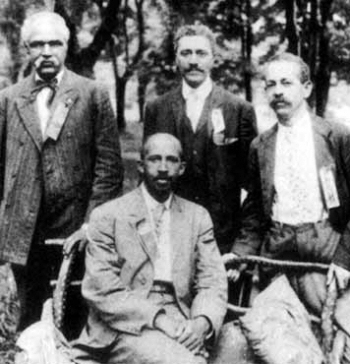
On this date, in 1897, the American Negro Academy (ANA) was founded. Originating in Washington, D.C., the ANA was created by Rev. Alexander Crummell, the son of a West African Tribal Chief (Temme Tribe) and an American literary advocate.
After ANA’s start, five primary objectives were instituted. Those objectives were: defense of the Negro against vicious assaults, publication of scholarly works, fostering higher education among Negroes, formulation of intellectual taste, and promoting literature, science, and art. The ANA was the first and only organization in America at that time to bring together Black artists and scholars worldwide.
By 1918, ANA had produced literary and scholarly works such as: “The Training of the Negro Ministry” by J. E. Moorland, “Comparative Study of the Negro Problem” by Charles C. Cook, “Disfranchisement of the Negro” by J. L. Lowe, “A Review of Hoffman’s Race Traits and Tendencies of the American Negro” by Kelly Miller, “The Status of the Free Negro from 1860-1970” by William Pickens, “Economic Contribution by the Negro of America” by Arthur Schomburg, and many others. In 1924, the ANA faded away. Decades later, the ANA was regenerated by interested poets, historians, dancers, essayists, musicians, dramatists, novelists, actors, journalists, scholars, painters, etc.
These artists and scholars needed to rejuvenate the Academy, which led to major meetings.
[…]
The result was the Black Academy of Arts and Letters (BAAL). Founded to carry on the tradition and mission of the ANA, BAAL was chartered and incorporated as a non-profit, tax-exempt organization by the State of New York on June 12, 1969.
Discover more Black history in our virtual exhibits.
Comments Are Welcome
Note: We moderate submissions in order to create a space for meaningful dialogue, a space where museum visitors – adults and youth –– can exchange informed, thoughtful, and relevant comments that add value to our exhibits.
Racial slurs, personal attacks, obscenity, profanity, and SHOUTING do not meet the above standard. Such comments are posted in the exhibit Hateful Speech. Commercial promotions, impersonations, and incoherent comments likewise fail to meet our goals, so will not be posted. Submissions longer than 120 words will be shortened.
See our full Comments Policy here.