The Lost Promise of Reconstruction
Share
Explore Our Galleries









Breaking News!
Today's news and culture by Black and other reporters in the Black and mainstream media.
Ways to Support ABHM?
By
Among the unanticipated consequences of the election of Donald Trump has been a surge of interest in post-Civil War Reconstruction, when this country first attempted to construct an interracial democracy, and in the restoration of white supremacy that followed. Many Americans feel that we are living at a time like the end of the 19th century, when, in the words of Frederick Douglass, “principles which we all thought to have been firmly and permanently settled” were “boldly assaulted and overthrown.”
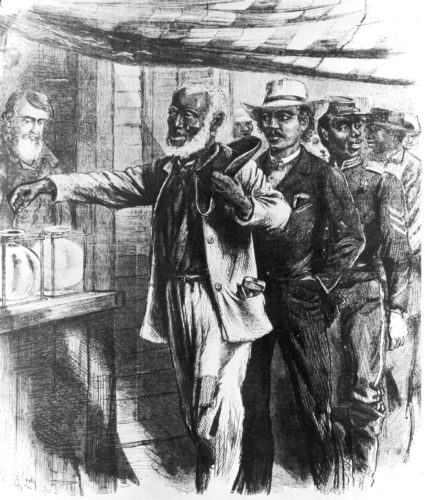
An 1867 illustration from Harper’s Weekly of African-American men voting in a state election in the South. Credit Hulton Archive/Getty Images
Douglass was referring to the rights enshrined in three constitutional amendments ratified between 1865 and 1870. The 13th Amendment irrevocably abolished slavery. The 14th constitutionalized the principles of birthright citizenship and equality before the law. The 15th sought to guarantee the right to vote for black men throughout the reunited nation. All three empowered Congress to enforce their provisions, radically shifting the balance of power from the states to the nation…
The 13th Amendment quickly fell into disuse. The court assumed that its purpose was fulfilled when chattel slavery vanished and rejected claims that various forms of racial inequality that persisted amounted to “badges of slavery” against which Congress could legislate. The justices reduced the “privileges or immunities” guaranteed to American citizens in the 14th to virtual insignificance, insisting that most rights still derived from state, not national, citizenship. The court elevated state action into a shibboleth, severely restricting federal protection of rights against the assaults of violent individuals and mobs. It refused to intervene as the South’s black men lost the right to vote. The justices mainly used the 14th Amendment as a vehicle to protect the “liberty” of corporations, not that of the former slaves, striking down state laws regulating economic activity on the grounds that they violated the rights of “corporate personhood.” Only John Marshall Harlan, black Americans’ most steadfast friend in the federal judiciary during this period, consistently dissented from what he called the court’s “entirely too narrow and artificial” reading of the three amendments…
Why should we care today about these long-ago decisions? Because in a legal environment that relies so heavily on precedent the shadow of the retreat from Reconstruction still hangs over contemporary jurisprudence. To this day, the 13th Amendment has almost never been invoked as a weapon against the racism that formed so powerful a bulwark of American slavery. The right to vote remains insecure. In 2013, the Supreme Court invalidated the 1965 Voting Rights Act’s requirement that jurisdictions with long histories of discrimination in voting obtain prior federal approval before changing suffrage rules. Many states have interpreted the decision as a green light to enact laws to restrict the voting population in ways that predominantly affect racial minorities and the poor…
Read full article here
More Breaking News here
View more ABHM galleries here
Comments Are Welcome
Note: We moderate submissions in order to create a space for meaningful dialogue, a space where museum visitors – adults and youth –– can exchange informed, thoughtful, and relevant comments that add value to our exhibits.
Racial slurs, personal attacks, obscenity, profanity, and SHOUTING do not meet the above standard. Such comments are posted in the exhibit Hateful Speech. Commercial promotions, impersonations, and incoherent comments likewise fail to meet our goals, so will not be posted. Submissions longer than 120 words will be shortened.
See our full Comments Policy here.