The Great Erasure
Share
Explore Our Galleries









Breaking News!
Today's news and culture by Black and other reporters in the Black and mainstream media.
Ways to Support ABHM?
By Charles Blow, The New York Times
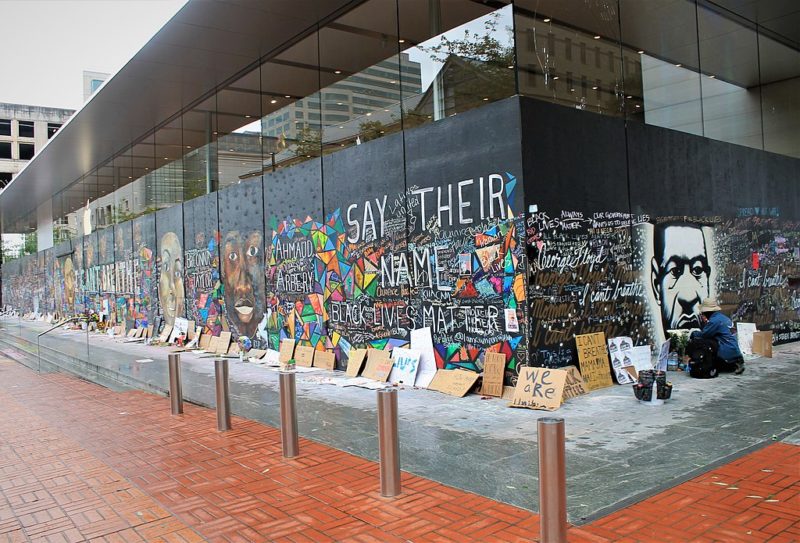

Two years after George Floyd’s murder, the street art created during that summer’s uprising—and the hope it inspired—is fading away.
WEDNESDAY will be the second anniversary of the lurid street murder of George Floyd by a Minneapolis police officer. The killings of Black people had become almost banal in their incessancy and redundancy, but something about this one — captured during an advancing pandemic that had forced people apart and inside, watching the world through windows and screens — drew thousands of people out into the streets, where boarded-up storefronts produced the tempting tableau of a country strewn with canvases.
Some saw in the uprising the potential for revolution. They talked about the protests in the lofty language of a “racial reckoning,” an “inflection point,” a fresh start on America’s path to absolution from its original sin.
But flashes of guilt, outrage and shame often stir fleeting fealties, and the heavy gravitational pull of racial privileges and power can quickly draw mercurial allies back into the refuge of the status quo.
Some good came of the protests, to be sure. Some states and local municipalities passed or instituted police reforms. Money poured into Black Lives Matter, as well as other racial justice organizations and Black institutions. Individuals began personal journeys to become more egalitarian and more actively “antiracist.” And artists produced hundreds of murals and thousands of pieces of other street art that, for a time, transformed this country.
In the end, transformative national change proved to be an illusion. Inflation, a war in Ukraine, public safety, abortion and even a baby formula crisis have overtaken the zeitgeist. Support for Black Lives Matter has diminished. Federal police reform and federal voter protection both failed to pass the Senate. And the founders of Black Lives Matter have been drawn into controversies about how they handled its money.
Keep reading Blow’s criticism about BLM losing steam.
While For example, posters and signs left near the White House during a 2020 protest will be preserved by the Library of Congress, and the SoFi museum recently opened an exhibit about Black history.
Black Lives Matter is still working toward change, and you can find recent updates here.
Comments Are Welcome
Note: We moderate submissions in order to create a space for meaningful dialogue, a space where museum visitors – adults and youth –– can exchange informed, thoughtful, and relevant comments that add value to our exhibits.
Racial slurs, personal attacks, obscenity, profanity, and SHOUTING do not meet the above standard. Such comments are posted in the exhibit Hateful Speech. Commercial promotions, impersonations, and incoherent comments likewise fail to meet our goals, so will not be posted. Submissions longer than 120 words will be shortened.
See our full Comments Policy here.