The Grassroots Fight for Housing Justice in Baltimore
Share
Explore Our Galleries









Breaking News!
Today's news and culture by Black and other reporters in the Black and mainstream media.
Ways to Support ABHM?
Bi Jaisal Noor, Yes Magazine
Tired of waiting for the city to address housing justice, Baltimore’s constellation of grassroots activists and institutions are charging forward to keep residents in their homes and increase availability of affordable housing.
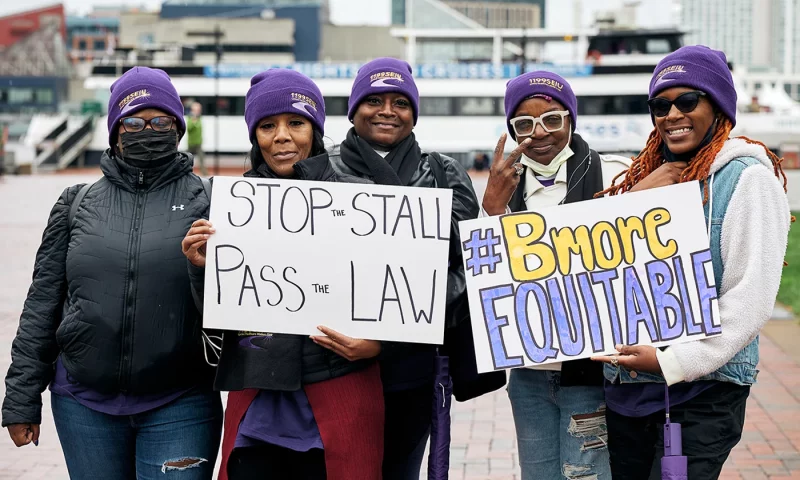
Sonia Eaddy never lost faith that she would be able to save her home at 319 North Carrollton Ave. in the Poppleton neighborhood of West Baltimore.
Like they have done to many predominantly-Black neighborhoods, developers have targeted Poppleton for years. Over the past decade, the city used eminent domain to evict residents and raze their houses, resulting in the displacement of longtime residents.
But last year, Eaddy, who is a third-generation resident of Poppleton, was able to mobilize a citywide coalition that staged rallies, packed public hearings, and collected over 5,000 signatures to save homes like hers from destruction. Even after most of Eaddy’s neighbors were forced out of their homes, after surrounding blocks were demolished, and after she exhausted legal appeals, she never stopped fighting.
In July 2022, her activism paid off when the city agreed to allow Eaddy to stay in her home. But she says it’s hard to call that a victory until her neighbors who were displaced have an opportunity to return. “We are continually working to help bring back those who were displaced,” she says.
As part of the deal the city reached with stakeholders, some residents may have the opportunity to return to their homes. Eleven historic alley houses—which are small homes typically occupied by African Americans or immigrant laborers—on the 1100 block of Sarah Ann Street, located next to Eaddy’s, will be renovated for homeownership in preparation for displaced former residents.
The group tasked with the renovation project is Black Women Build, a homeownership and wealth-building initiative that trains Black women in carpentry home restoration by rehabbing some of the 15,000 vacant and deteriorated houses in the city.
Black Women Build is one part of a larger ecosystem of grassroots groups addressing the racial and economic disparities created and perpetuated by unjust housing policy in Baltimore. Other efforts, working in tandem to strive for justice in housing, include housing associations, the city’s affordable housing trust fund, a blight-fighting social justice group, and an equitable development company that restores abandoned homes to increase affordable housing stock.
Noor tackles why previous solutions failed to help the situation.
In Baltimore, food insecurity is also a problem.
Check out more stories like this.
Comments Are Welcome
Note: We moderate submissions in order to create a space for meaningful dialogue, a space where museum visitors – adults and youth –– can exchange informed, thoughtful, and relevant comments that add value to our exhibits.
Racial slurs, personal attacks, obscenity, profanity, and SHOUTING do not meet the above standard. Such comments are posted in the exhibit Hateful Speech. Commercial promotions, impersonations, and incoherent comments likewise fail to meet our goals, so will not be posted. Submissions longer than 120 words will be shortened.
See our full Comments Policy here.