The day police bombed a city street: can scars of 1985 Move atrocity be healed?
Share
Explore Our Galleries









Breaking News!
Today's news and culture by Black and other reporters in the Black and mainstream media.
Ways to Support ABHM?
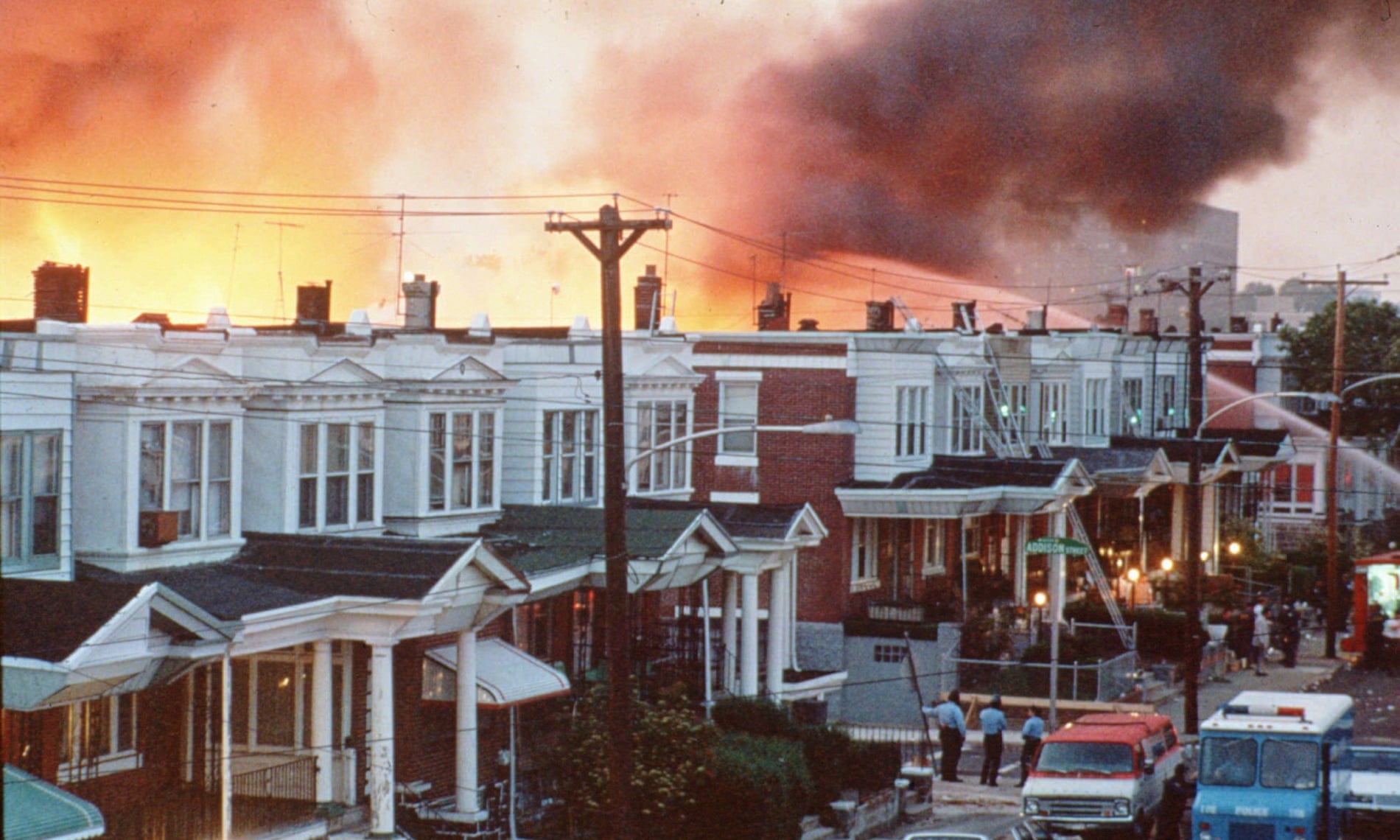
Row houses in Philadelphia burn after policed dropped a bomb on the Move house in May 1985. Photograph: AP
Eleven people, including five children, died and a Philadelphia neighborhood burned down in the airstrike against a black liberation group. Now an effort at reconciliation is under way
By Ed Pilkington, the guardian.com
Frank Powell, a Philadelphia police officer who in 1985 was chief of the city’s bomb disposal squad, remembers vividly the moment he was given his instructions. “Wow,” he recalls thinking. “You want me to do that?”
On 13 May 1985 Powell was handed an army-style green satchel containing a bomb made of C-4 plastic explosives of the sort widely deployed in Vietnam. He boarded a state police helicopter, and took up his position balanced precariously on the skids of the aircraft.
“I can’t remember being scared,” he told the Guardian, “though I must have been.”
At 5.27pm as the helicopter rose into a crystal-clear blue sky he carried out his orders. Flying over a largely African American residential neighborhood of west Philadelphia, he lined up his sights, lit the 45-second fuse with a military igniter and followed his orders.
“I reached out and I dropped it. Perfect. It was going right where it was supposed to go…”
His target was the roof of 6221 Osage Avenue, a row house which at the time had 13 American citizens inside. They were all members of Move, a group which combined the black liberation struggle with back-to-nature environmentalism.
Each Move member took the last name Africa to signal their commitment to race equality as well as to each other as a family. For years they had been in a running battle with the Philadelphia authorities culminating that May in arrest warrants, for a range of offenses including “terroristic threats”, “riot” and “disorderly conduct”, being served and a standoff ensuing that ended with the dropping of Powell’s bomb on to their house.
It led to one of the great, largely forgotten, outrages of modern America…
Full article here
More Breaking News
ABHM galleries here
Comments Are Welcome
Note: We moderate submissions in order to create a space for meaningful dialogue, a space where museum visitors – adults and youth –– can exchange informed, thoughtful, and relevant comments that add value to our exhibits.
Racial slurs, personal attacks, obscenity, profanity, and SHOUTING do not meet the above standard. Such comments are posted in the exhibit Hateful Speech. Commercial promotions, impersonations, and incoherent comments likewise fail to meet our goals, so will not be posted. Submissions longer than 120 words will be shortened.
See our full Comments Policy here.