The Civic Promise of Juneteenth
Share
Explore Our Galleries









Breaking News!
Today's news and culture by Black and other reporters in the Black and mainstream media.
Ways to Support ABHM?
By Tobin Miller Shearer, TIME Magazine
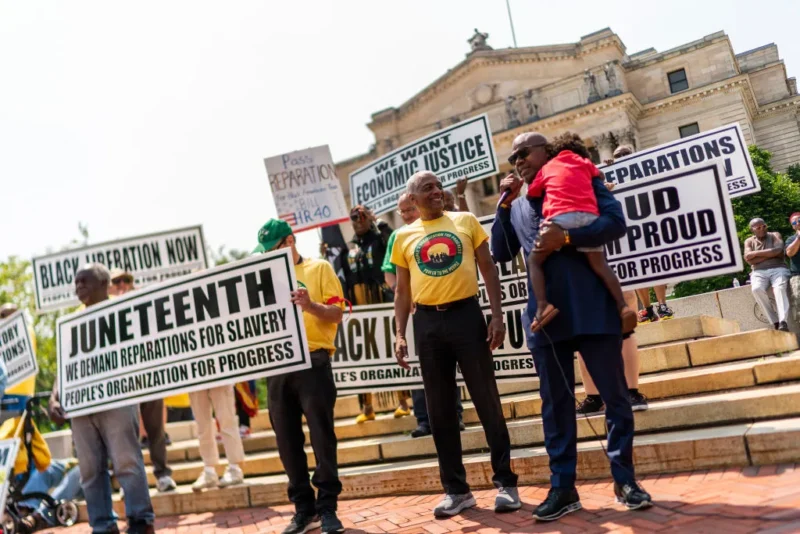
While Martin Luther King, Jr.’s January birthday has been a national holiday for nearly four decades, the four-year-old Juneteenth federal holiday already holds greater promise for civic education.
Precisely because a more racially contentious dynamic has unfolded around Juneteenth, this relatively recent celebration has opened the door to a focused telling of Black history. By contrast the relatively lukewarm reception to Martin Luther King Jr. Day has made education about difficult stories from our nation’s past less likely. Juneteenth, on the other hand, holds more promise for honest encounters with a past often obscured by the politics of the present.
Unlike the 2021 unanimous Senate vote and 415-14 House tally in favor of the Juneteenth holiday, the 1983 voting process for the King holiday was lengthy and conflictual. Having failed passage in both 1968 and 1979, the bill finally became law in 1983 but only after a Senate filibuster had been defeated and the House two-thirds majority mustered. At the state level, New Hampshire, the last state to establish a holiday to honor King by name, did not do so until 2000.
Pundits at the time conjectured that such a contentious legislative process would foster ongoing dissension. Contrary to this prediction, however, the celebration of the King holiday soon lost its political edge. Only a year after the first celebration of the holiday, noted civil rights historian and author Vincent Harding observed in the September 1987 edition of the Journal of American History that the country had developed “a massive case of national amnesia” by stripping King of his prophetic and revolutionary messages. As a result, the holiday rarely stirred new controversies.
By contrast, the establishment of Juneteenth as a federal holiday in 2021 offered a rare moment of bi-partisan support for racially conscious legislation. But the subsequent record of Juneteenth celebrations has been far more mixed. To be certain, this new holiday has popularized the Juneteenth history. The delay in announcing an end to slavery to the quarter million enslaved people in Texas is now much more widely known. Where once the account of the army’s arrival in Galveston, Texas, on June 19, 1865, rarely circulated outside African-American circles, the narrative is now told on an annual basis in thousands of celebrations across the country.
At the same time, tensions around Juneteenth celebrations have increased in the wake of the initial bi-partisan consensus.
Find more Breaking News here.
Learn more about Black history in our virtual exhibit galleries.
Comments Are Welcome
Note: We moderate submissions in order to create a space for meaningful dialogue, a space where museum visitors – adults and youth –– can exchange informed, thoughtful, and relevant comments that add value to our exhibits.
Racial slurs, personal attacks, obscenity, profanity, and SHOUTING do not meet the above standard. Such comments are posted in the exhibit Hateful Speech. Commercial promotions, impersonations, and incoherent comments likewise fail to meet our goals, so will not be posted. Submissions longer than 120 words will be shortened.
See our full Comments Policy here.