Special News Series: Rising Up For Justice! – Milwaukee protesters begin march to Washington, D.C.
Share
Explore Our Galleries









Breaking News!
Today's news and culture by Black and other reporters in the Black and mainstream media.
Ways to Support ABHM?
Introduction To This Series:
This post is one installment in an ongoing news series: a “living history” of the current national and international uprising for justice.
Today’s movement descends directly from the many earlier civil rights struggles against repeated injustices and race-based violence, including the killing of unarmed Black people. The posts in this series serve as a timeline of the uprising that began on May 26, 2020, the day after a Minneapolis police officer killed an unarmed Black man, George Floyd, by kneeling on his neck. The viral video of Floyd’s torturous suffocation brought unprecedented national awareness to the ongoing demand to truly make Black Lives Matter in this country.
The posts in this series focus on stories of the particular killings that have spurred the current uprising and on the protests taking place around the USA and across the globe. Sadly, thousands of people have lost their lives to systemic racial, gender, sexuality, judicial, and economic injustice. The few whose names are listed here represent the countless others lost before and since. Likewise, we can report but a few of the countless demonstrations for justice now taking place in our major cities, small towns, and suburbs.
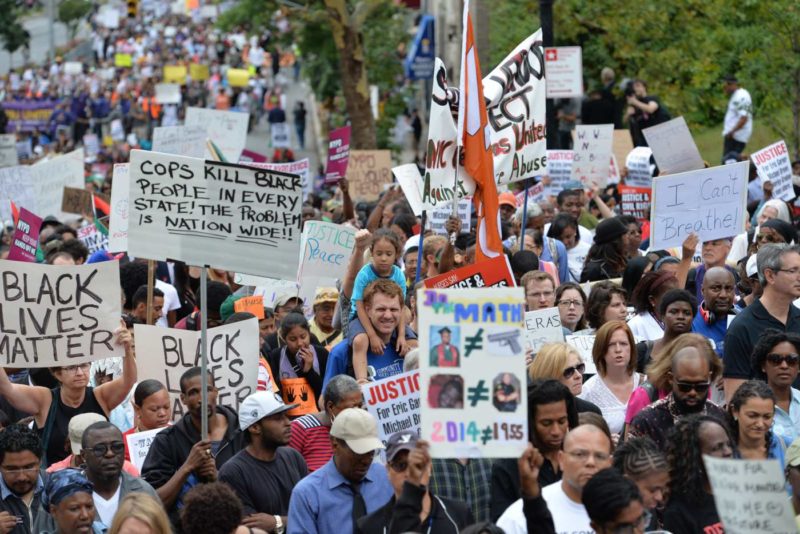
To view the entire series of Rising Up for Justice! posts, insert “rising up” in the search bar above.
‘There’s no way to stop us’: Milwaukee protesters begin march to Washington, D.C.
By Ricardo Torres, Milwaukee Journal Sentinel
August 4, 2020
Day one of a long march that hopes to end in Washington, D.C., started across the street from Buy Right Auto Parts and Country Pump Bar in Caledonia on Tuesday.
“We’ve been marching, like, 20 miles a day for a while now, so why don’t we have a destination that lets us know that we did something?” activist Frank Sensabaugh said. “That prepared us.”
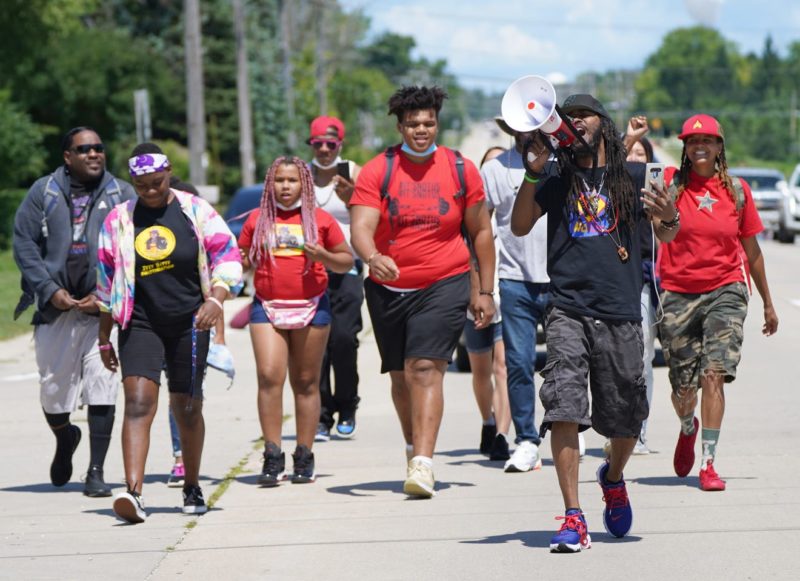
Sensabaugh, also known as Frank Nitty, organized the march to coincide with the 57th anniversary of Martin Luther King Jr.’s famous “I Have A Dream” speech. The group hopes to arrive in the nation’s capital by Aug. 28.
The march hopes to bring awareness to racial inequity and police brutality.
“Would (elected officials) change legislation because of this march? I doubt it,” Sensabaugh said. “But will they see and hear us from this march? They definitely will.”
A group of about 20 people gathered at Haas Park in Oak Creek and drove to the intersection of Ole Davidson Road and West Johnson Avenue in Caledonia to begin the nearly 750-mile march.
There were about five cars filled with food and supplies that drove ahead of the group at a low speed. Each marcher took their own precautions to make sure they were hydrated and comfortable to make the long walk.
Sensabaugh bought new shoes specifically for the march.
“There’s no way to stop us,” Sensabaugh said. “We’re not going back at all. This march is going to happen, the whole 750 miles. For me, it’s like a roller coaster. Once you buckle up and get on, there’s no way out until the end.”
Read the full article here.
Comments Are Welcome
Note: We moderate submissions in order to create a space for meaningful dialogue, a space where museum visitors – adults and youth –– can exchange informed, thoughtful, and relevant comments that add value to our exhibits.
Racial slurs, personal attacks, obscenity, profanity, and SHOUTING do not meet the above standard. Such comments are posted in the exhibit Hateful Speech. Commercial promotions, impersonations, and incoherent comments likewise fail to meet our goals, so will not be posted. Submissions longer than 120 words will be shortened.
See our full Comments Policy here.