Series of Brooklyn Billboards Put Racial Inequity on Display
Share
Explore Our Galleries









Breaking News!
Today's news and culture by Black and other reporters in the Black and mainstream media.
Ways to Support ABHM?
By Jamilah King, Colorlines
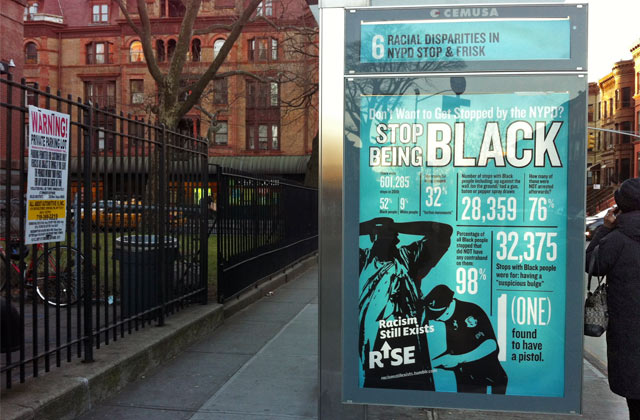
Billboards are everywhere in New York City. They’re on subway trains and in stations, and on top of and inside taxis.
But few, if any, have been anything like a series of anonymous billboards that have popped up on bus shelters in the Bedford-Stuyvesant neighborhood of Brooklyn. They’re not selling anything but a delcaration: that racism still exists.
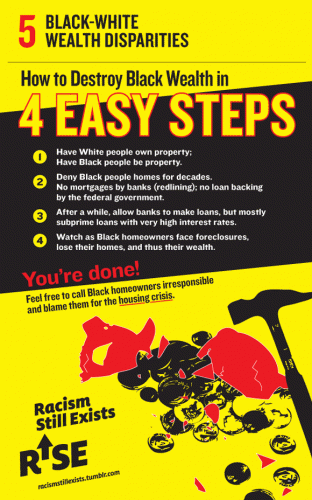
That’s also the name of the appropriately titled campaign. At least half a dozen billboard sites have sprung up around the neighborhood since August, with each month dedicated to highlighting racial disparities that impact black people in America. So far, the billboards have touched on topics ranging from the entertainment industry, education, fast food, smoking, policing, and black wealth. Each month’s billboard is also accompanied by a detailed post on Tumblr that provides background information, news articles, studies, charts, and statistics to back up each claim.
A brief statement on the Tumblr page says, in part, that “RISE is a proejct designed to illuminate some of the ways in which racism operates in this country.” But who’s behind the project remains a mystery.
Read more about this poster campaign here.
See more posters here and read their background information by clicking on each poster.
Read more Breaking News here.
Comments Are Welcome
Note: We moderate submissions in order to create a space for meaningful dialogue, a space where museum visitors – adults and youth –– can exchange informed, thoughtful, and relevant comments that add value to our exhibits.
Racial slurs, personal attacks, obscenity, profanity, and SHOUTING do not meet the above standard. Such comments are posted in the exhibit Hateful Speech. Commercial promotions, impersonations, and incoherent comments likewise fail to meet our goals, so will not be posted. Submissions longer than 120 words will be shortened.
See our full Comments Policy here.