Sacrificing Black Lives for the American Lie
Share
Explore Our Galleries









Breaking News!
Today's news and culture by Black and other reporters in the Black and mainstream media.
Ways to Support ABHM?
By: IBRAM X. KENDI, nytimes.com
Why are police officers rarely charged for taking black lives, and when they are, why do juries rarely convict?
Many Americans asked this question when a Minnesota jury decided that Philando Castile was responsible for his own death and that the officer who shot him, did nothing wrong.

Philando Castile
Many Americans asked it again a few days later, when the police released the seemingly damning video from the dashboard camera of Officer Yanez’s patrol car….
We may never know why justice is still segregated from black death. Prosecutors, like juries deliberate behind closed doors. But that has not stopped people trying to find answers. On one side, people say: America is racist, and jurors are like cops — they hate black people….
Many Americans — possibly most — think the criminal justice system is fair. Nearly 63 million Americans elected a president who rejects the idea that there is a systemic war against black people and accepts the idea that there is a systemic war against cops. A survey by the Pew Research Center last year found that 50 percent of whites feel the races are treated equally by the police, compared with 16 percent of blacks. Even more whites feel the races are treated equally in the courts. The survey found that 38 percent of whites think their country has no more racial work to do.

A memorial in Ferguson, Mo., where Michael Brown was killed by the police in 2014.
These Americans refuse to see their country as a place where racist politicians and judges maintain laws that form a racist criminal justice system that produces and defends racist cops who disproportionately kill innocent black people. When they are told that black males aged 15 to 34 were nine times more likely than other Americans to be killed by police officers last year, they assume something must be wrong with those young men, since discrimination is over….
“Post-racial” is a new term with an old pedigree. Ever since Thomas Jefferson wrote “all men are created equal,” Americans have seen their nation as post-racial, as egalitarian.
As a result, Americans defended slavery by characterizing it as a necessary evil or a positive good….
This blaming of the black victim stands in the way of change that might prevent more victims of violent policing in the future. Could it be that some Americans would rather black people die than their perceptions of America? Is black death more palatable than accepting the racist reality of slaveholding America, of segregating America, of mass-incarcerating America? Is black death the cost of maintaining the myth of a just and meritorious America?
And in exonerating the police officer and America of racism, people end up exonerating themselves. Americans who deeply fear black bodies, who think their fears are sensible, can empathize when cops like Officer Yanez testify that they feared for their lives.
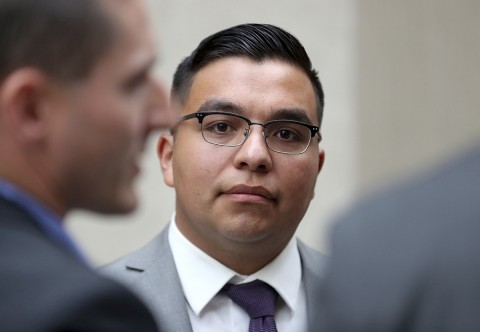
Jeronimo Yanez stands outside the Ramsey County Courthouse while waiting for a ride in St. Paul, Minn. (David Joles/Star Tribune via AP, File)
To diagnose police officers’ lethal fears as racist, juries and prosecutors would also have to diagnose their own fears of black bodies as racist. That is a tall task. It may even be easier to get a racist cop convicted of murdering a black person than it is to get a racist American to acknowledge his or her own racism. Racist Americans keep justice as far away from black death as possible to keep the racist label as far away from themselves as possible….
Black people and the post-racial myth cannot both live in the United States of America.
Read the full article here.
Read more Breaking news here.
Comments Are Welcome
Note: We moderate submissions in order to create a space for meaningful dialogue, a space where museum visitors – adults and youth –– can exchange informed, thoughtful, and relevant comments that add value to our exhibits.
Racial slurs, personal attacks, obscenity, profanity, and SHOUTING do not meet the above standard. Such comments are posted in the exhibit Hateful Speech. Commercial promotions, impersonations, and incoherent comments likewise fail to meet our goals, so will not be posted. Submissions longer than 120 words will be shortened.
See our full Comments Policy here.