Republicans work to recruit female and minority candidates even as they criticize diversity programs
Share
Explore Our Galleries









Breaking News!
Today's news and culture by Black and other reporters in the Black and mainstream media.
Ways to Support ABHM?
From NBC in partnership with the Associated Press
Republican lawmakers in at least 17 states have proposed some three dozen bills to restrict or require public disclosure of DEI initiatives, according to an Associated Press analysis.
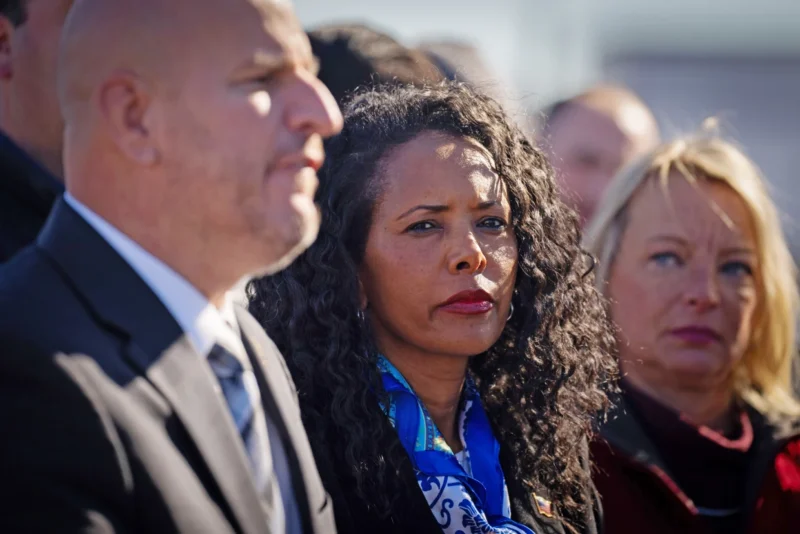
House Republicans are critical of diversity and inclusion programs within the federal government and elsewhere, but they see recruiting women and minority candidates, along with veterans, as key to expanding their slim majority in November.
Rep. Richard Hudson, the chairman of the National Republican Congressional Committee, recently listed for reporters a slew of candidates that he described as fitting the “formula” for the GOP expanding their ranks in November.
There was Prasanth Reddy, a cancer doctor who immigrated to the U.S. from India and joined the military after the Sept. 11, 2001, terrorist attacks. He’s running for a congressional seat in northeast Kansas. Then there was Alison Esposito, a gay former police detective running for a seat in New York.
Another example Hudson cited was George Logan, whose parents came to the U.S. from Guatemala and is running for a seat in Connecticut. Also, there’s Kevin Lincoln, an African-American and Hispanic mayor in Stockton, Calif., and Mayra Flores, who is making another run. She made history by becoming the first Mexican-born congresswoman, but she subsequently lost in the 2022 mid-terms.
“These are not run-of-the-mill generic Republicans,” Hudson said.
Republicans are hoping the gains they made in the 2022 midterm elections will continue with their latest slate of candidates. House Democrats have a sizeable advantage when it comes to minority voters and don’t intend to cede any ground, announcing a $35 million investment last month focused on reaching out to voters of color through polling, organizing and ads. The contest to appeal to female and minority voters will certainly be one of the factors determining which party controls the House next year.
Read this Breaking News article to learn what the Democrats are doing to appeal to minority voters.
Find even more Breaking News here.
Comments Are Welcome
Note: We moderate submissions in order to create a space for meaningful dialogue, a space where museum visitors – adults and youth –– can exchange informed, thoughtful, and relevant comments that add value to our exhibits.
Racial slurs, personal attacks, obscenity, profanity, and SHOUTING do not meet the above standard. Such comments are posted in the exhibit Hateful Speech. Commercial promotions, impersonations, and incoherent comments likewise fail to meet our goals, so will not be posted. Submissions longer than 120 words will be shortened.
See our full Comments Policy here.