Rematriating the Milwaukee singer who was the 1st African-American woman cantor
Share
Explore Our Galleries









Breaking News!
Today's news and culture by Black and other reporters in the Black and mainstream media.
Ways to Support ABHM?
By Bobby Tanzilo, On Milwaukee
Milwaukee African-American Jewish singer Shahanna McKinney Baldon is working to restore the legacy of Goldye Steiner, an earlier Milwaukee African-American singer, and to buy a marker for her grave.
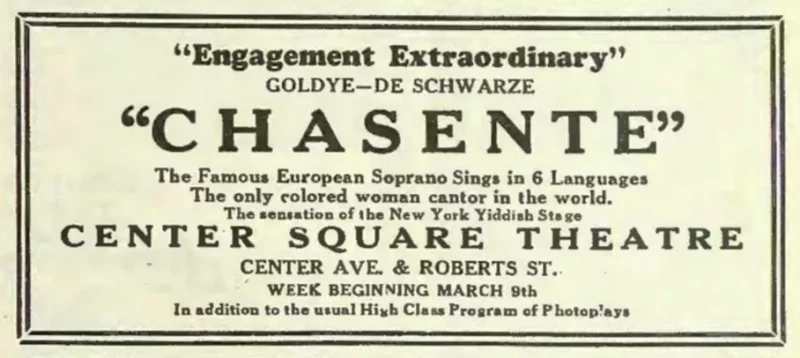
When Milwaukee native Shahanna McKinney Baldon took the stage at the Brooklyn Bowl in Williamsburg in September to sing the centuries-old Berdichever Kaddish at the “Hidden Melodies Revealed 15” Rosh Hashanah event, she did so in the voice of, and in tribute to, another Milwaukee African-American singer, Gladys Mae Sellers, aka Madame Goldye Steiner.
McKinney Baldon – who now lives in Madison, but was raised on the upper East Side and was active in the Milwaukee music scene with bands like Mood Groove and the recently revived Highball Holiday – has been studying the life and work of Sellers, who has been called the first African-American woman cantor.
[…]
McKinney Baldon is working to research Madame Goldye’s life and work and also to raise money for a marker for the singer’s unmarked Milwaukee grave.
“Like Madame Goldye, I, too, am a Black woman from Milwaukee who sings Jewish liturgical music,” says McKinney Baldon. “I was so excited to learn of this pioneering artist and her Milwaukee roots, that I am dedicating myself to stewarding a reconnection of her story with the story of Black Milwaukee.”
Born in 1889 in Illinois as Gladys Mae Sellers, Goldye was raised in Milwaukee and over the course of her career performed in Hebrew, Yiddish, Russian, German, French and English.
As a young adult, McKinney Baldon says, Sellers sang across the upper Midwest – in Milwaukee, Chicago, Minneapolis, Madison and beyond – sometimes with her then-husband, Albert Smack.
OnMilwaukee has details about Sellers’ career.
Goldye’s success is especially impressive because tensions have often run high between Black and Jewish communities. However, we shouldn’t forget important cooperation.
Comments Are Welcome
Note: We moderate submissions in order to create a space for meaningful dialogue, a space where museum visitors – adults and youth –– can exchange informed, thoughtful, and relevant comments that add value to our exhibits.
Racial slurs, personal attacks, obscenity, profanity, and SHOUTING do not meet the above standard. Such comments are posted in the exhibit Hateful Speech. Commercial promotions, impersonations, and incoherent comments likewise fail to meet our goals, so will not be posted. Submissions longer than 120 words will be shortened.
See our full Comments Policy here.