Protecting history: Meet MKE’s rare books librarian (and ABHM Board member)
Share
Explore Our Galleries









Breaking News!
Today's news and culture by Black and other reporters in the Black and mainstream media.
Ways to Support ABHM?
By Jim Higgins, Milwaukee Journal Sentinel
As a 16-year-old, Maria Cunningham visited the Milwaukee Public Library’sCentral Library to borrow an old book for a school report — to be told the one librarian who could assist her was out that day.
That book on the old Layton Art Gallery was in the library’s Rare Books Room, and only the rare books librarian could show it to Cunningham.
This revelation — Milwaukee has a rare books room! — got the bookish Cunningham excited. “That is so cool,” Cunningham said, remembering that day. “I really want to get in there.”
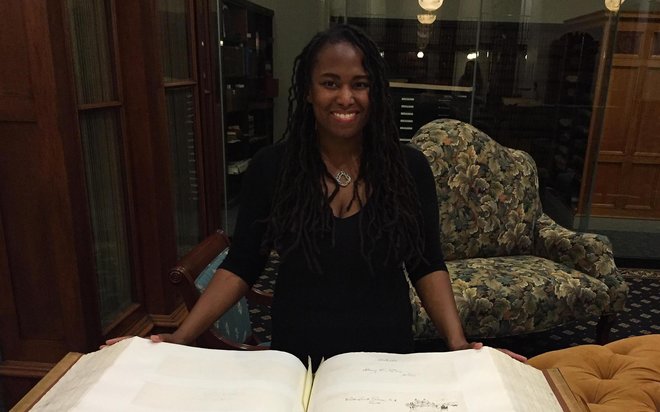
Rare Books Librarian Maria Cunningham with the 50 lb. Autograph Book. Photo by Jim Higgins.
What was teenage excitement then is now the glow of professional achievement: Cunningham recently became Milwaukee Public Library’s rare books librarian. In her new domain, the Richard E. & Lucille Krug Rare Books Room, a collection of thousands of books, artworks and unique items, Cunningham has charge of such treasures as John James Audubon’s “Birds of America” series of 435 hand-colored prints (1827-1838), and the “Hypnerotomachia Poliphili,” a gilt-edged Renaissance book published in 1499.
Cunningham rolled out one of the library’s prize items: the 50-pound “Autograph Book” (1898), filled with signatures of late 19th-century celebrities such as Mark Twain, Booker T. Washington, Woodrow Wilson and Rudyard Kipling. Composers and musicians, such as John Philip Sousa, added bars of music to their signatures; artists including Maxfield Parrish enhanced their John Hancocks with sketches and illustrations. Artist Lydia Ely dreamed up the book to raise funds to build “The Victorious Charge,” a bronze Civil War memorial at N. 10th St. and W. Wisconsin Ave.
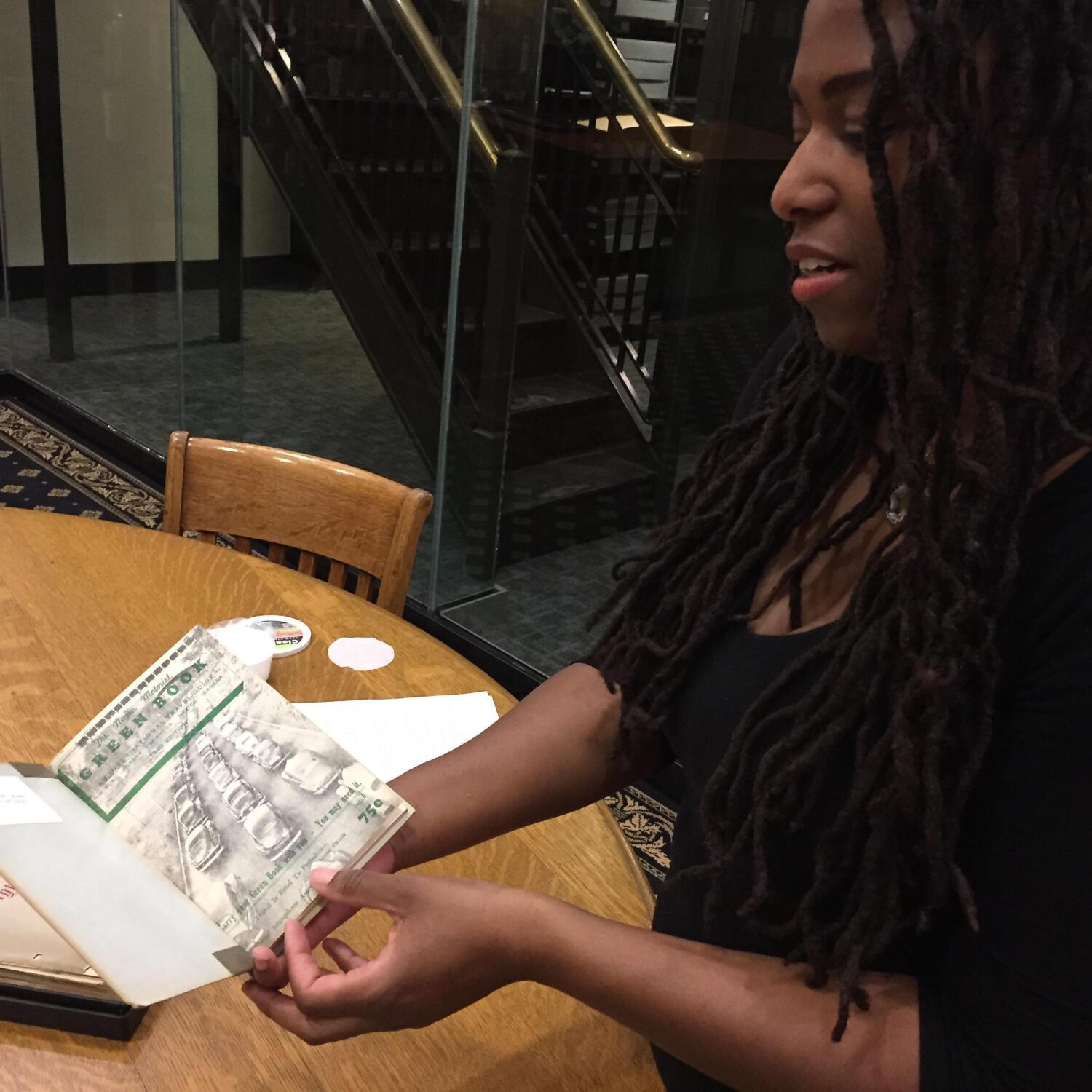
Cunningham sits on the board of the Dr. James Cameron Legacy Foundation, which runs America’s Black Holocaust Museum. Here she displays the Negro Motorist’s Guide (also known as the Green Book) of 1936. Photo: Jim Higgins
A devotee of alternative history, Cunningham showed off a 1936 copy of “The Negro Motorist Green Book,” a cross-country guide for African-American travelers during the Jim Crow era. (Sadly, it lists only two safe locations in Wisconsin.)
Cunningham earned a master’s degree in library and information science at the University of Wisconsin-Milwaukee, with a certificate in museum studies. She joined the MPL staff first as historic photo librarian and then as digital projects librarian, working on making the library’s enormous collection of World War I portraits available online.
Her new post involves more than simply maintaining and explaining the collection. She evaluates books and documents from all library departments for their rare books potential. It’s not unheard of for another librarian to find something in a box, hand it to Cunningham, and ask her to figure out what it is and how rare it might be. Among many other criteria, Cunningham looks for special items from Wisconsin authors, such as a hand-colored Increase Lapham map from 1836.
“It’s really about the chase for me,” Cunningham said. “I really like the challenging questions.”
Comments Are Welcome
Note: We moderate submissions in order to create a space for meaningful dialogue, a space where museum visitors – adults and youth –– can exchange informed, thoughtful, and relevant comments that add value to our exhibits.
Racial slurs, personal attacks, obscenity, profanity, and SHOUTING do not meet the above standard. Such comments are posted in the exhibit Hateful Speech. Commercial promotions, impersonations, and incoherent comments likewise fail to meet our goals, so will not be posted. Submissions longer than 120 words will be shortened.
See our full Comments Policy here.