Poor People’s Campaign holds multi-state rallies calling for the end of US poverty
Share
Explore Our Galleries









Breaking News!
Today's news and culture by Black and other reporters in the Black and mainstream media.
Ways to Support ABHM?
By D.L. Chandler, The Grio
EXCLUSIVE: The events are the first of many ahead of the Mass Poor People’s & Low-Wage Workers’ Assembly and Moral March on Washington and to the Polls on June 18.
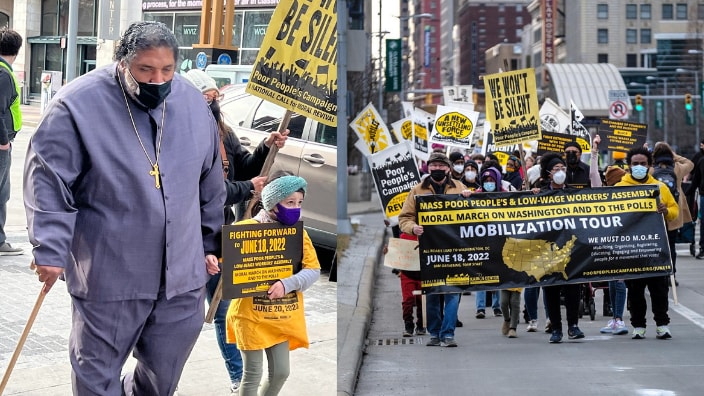
The mission of PPC: NCMR will be familiar to those who’ve studied the works of Rev. Martin Luther King, Jr., as it stands as a continuation of the civil rights leader’s call to address the concerns of poor, working class Americans. Today, the PPC: NCMR directs much of its efforts to what Rev. Barber refers to as the “moral center” of nation and bringing economic justice to those lowest on the rungs of greater society…
Further, Barber shared that over 40 million Americans made less than a living wage in the past year, no doubt impacted by the realities of the public health crisis many across the nation are still combating….
“If we’re going to talk about poverty and low wealth, we have to break through some false narratives,” Barber told theGrio. “First of all, we need to break through the lie of scarcity in a country, where we have a $22 trillion in gross domestic product, that we don’t have the resources to address those needs.”
Barber continued, “Secondly, we need to address the lie of that we don’t know what to do [about poverty]. We do know what to do, we know what the answers are. We know that we can use the tax codes, expand voting rights, and improve healthcare. We could fix all our issues instantly.”
The civil rights activist added, “The third lie is that poverty isn’t a fundamental, moral, and constitutional issue across the country, and it is. It is the moral issue of our time. And in addition to those lies we need to break through, we need to stop the lie that poverty is a deep south issue, or a Black issue, or the fact people are choosing to be poor.”
…In Ohio alone, Barber noted, 41% of state residents are considered poor and low-wage earners and he was clear to note that while people of color were most affected by poverty, a staggering number of whites in the state are also suffering under the weight of poverty.
Read the full story here.
To learn more about the PPC:NCMR’s upcoming activations and rallies, please visit this page.
Learn more about the Civil Rights campaigns that led to this point here, and specifically about the 1968 Poor People’s March on Washington that inspired the current campaign.
More Breaking News here.
Comments Are Welcome
Note: We moderate submissions in order to create a space for meaningful dialogue, a space where museum visitors – adults and youth –– can exchange informed, thoughtful, and relevant comments that add value to our exhibits.
Racial slurs, personal attacks, obscenity, profanity, and SHOUTING do not meet the above standard. Such comments are posted in the exhibit Hateful Speech. Commercial promotions, impersonations, and incoherent comments likewise fail to meet our goals, so will not be posted. Submissions longer than 120 words will be shortened.
See our full Comments Policy here.