New Book Claims the Destruction of Black Relationships Is ‘America’s Unrecognized Civil Rights Issue’
Share
Explore Our Galleries









Breaking News!
Today's news and culture by Black and other reporters in the Black and mainstream media.
Ways to Support ABHM?
By Janelle Harris Dixon, theRoot.com
The effort to explain why so many extraordinary Black women are involuntarily single has initiated one study after another, after another, and solicited the unflattering insights of many Black men who, just by default of being Black men, have been arbitrarily promoted to subject matter experts. What we’ve learned from that string of stumbles and missteps is that accurately writing about Black women and Black love requires an alchemy of rigorous scholarly research and thoughtful cultural analysis.
Dr. Dianne Stewart spent months excavating historical cases and firsthand accounts of Black women’s experiences for her new book, Black Women, Black Love: America’s War on African American Marriage. She taught her first “Black Love” course in 2004 at Emory University, where she’s an associate professor of religion and African-American Studies, to explore the historical presence and absence of love in Black folks’ lives through a range of contexts. At the time, she never imagined that her teaching and research would evolve into an in-depth and wide-reaching look at the history, economics, social science, and theology around being unpartnered.
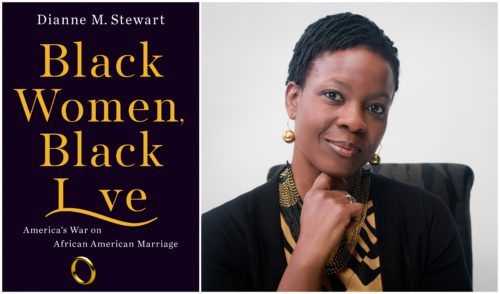
Image: Seal Press
Still, as both an academic and a formerly single sister, the intel she uncovered in her fact-finding was sometimes overwhelming, even to her. “I had physiological reactions to some of the material I was digging up. It wasn’t all new to me. Some of the stories were new, but the material wasn’t all new. So emotionally,” she said, “it was difficult to actually research and write the book, deal with the trauma and the terror, and figure out: how do I convey this? How do I narrate this to my readers?”
Stewart made what she says was “the difficult decision” to tackle Black Women, Black Love because there were no other books she could find that dissected the historic intentionality of making Black love and marriage difficult, delayed or impossible. She calls it “America’s unrecognized civil rights issue,” yet another consequence of the systemic and structural factors that began in the enslavement period, coursed through the Jim Crow era and, despite the achievements of education and enlightenment, followed us into the present.
Read the full article here.
Learn more about the historical impacts on current Black struggles here.
More Breaking News here
Comments Are Welcome
Note: We moderate submissions in order to create a space for meaningful dialogue, a space where museum visitors – adults and youth –– can exchange informed, thoughtful, and relevant comments that add value to our exhibits.
Racial slurs, personal attacks, obscenity, profanity, and SHOUTING do not meet the above standard. Such comments are posted in the exhibit Hateful Speech. Commercial promotions, impersonations, and incoherent comments likewise fail to meet our goals, so will not be posted. Submissions longer than 120 words will be shortened.
See our full Comments Policy here.