Miss Trans Africa’s Long Wait for Freedom
Share
Explore Our Galleries









Breaking News!
Today's news and culture by Black and other reporters in the Black and mainstream media.
Ways to Support ABHM?
By Nick Schönfeld and Julia Gunther, NPR
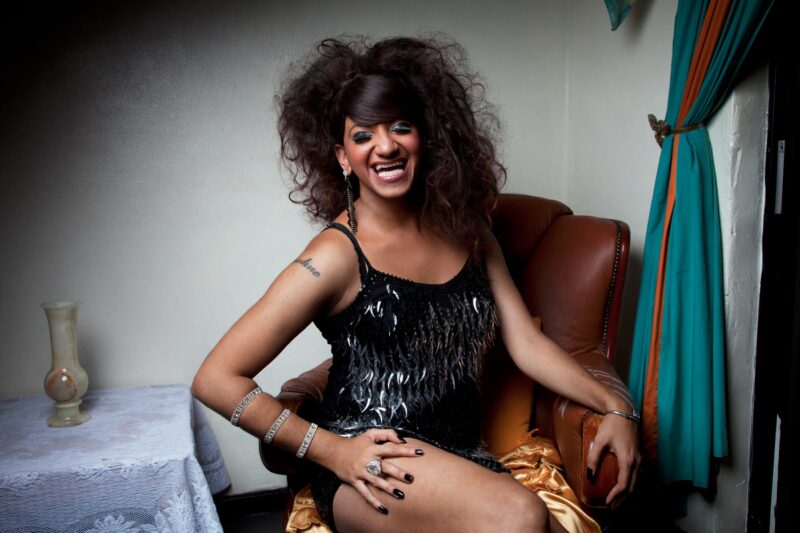
Chedino backstage during a performance of Divas in Cabaret at the Fergus Inn in Elsie’s River, Cape Town, South Africa, in 2012. (Julia Gunther, NPR)
One of Chedino Martin’s first memories is of a woman in red standing in the doorway of her grandmother’s house in Heideveld, a suburb in the Athlone part of Cape Town, South Africa. It was 1986. Chedino, 39, was only 3 years old at the time but still remembers the moment clearly.
“It was raining. There was this red cloak. Then it fell away, and I saw a gorgeous, elegant woman standing in a silver foil dress with these long black curls and this broad smile,” she recalls.
The woman in red was Chedino’s aunt, Sharon. Sharon had just won that year’s local chapter of the Spring Queen beauty pageant, a competition organized by textile workers. “I knew one day, someday, that was going to be me,” Chedino continues.
Chedino might have grown up surrounded by the glamor of pageantry — her mother and her aunt were both successful beauty queens — but her early childhood was filled with turbulence and pain.
Chedino’s biological father left before she was born and refused to accept her as his child. For a brief time, Chedino and her mother, Alma, were homeless. And sometime before Sharon’s fateful visit, Alma abandoned Chedino to go on holiday. Were it not for her aunt’s dropping by the house on Christmas Day only to find her niece lying on the floor, Chedino likely would have died from exposure.
[…]
In South Africa, beauty pageants have played an important role in the country’s social fabric since the beginning of the 20th century.
The Spring Queen competition, which is one of the oldest and largest pageants in South Africa, and in which Sharon participated, was established by the Southern African Clothing and Textiles Workers’ Union as a means of supporting the 1973 Durban strikes and the 1976 Soweto Uprising.
After 1994, as South Africa’s regime of segregation and discrimination was being torn down and Archbishop Desmond Tutu’s “The Rainbow Nation” was rising from the ruins, LGBTQ rights rose along with it.
Gradually, beauty pageants became an important platform for the lesbian, gay, bisexual, transgender, queer and intersex communities who used them to openly celebrate their identities, free from the fear of arrest or government persecution.
For as long as Chedino can remember, pageants have served as a form of therapy — and escape. “I don’t talk about my issues or troubles. Not even when things get really bad,” she explains. She followed every pageant she could find — Miss South Africa, Miss World, Miss Universe — as they allowed her to enter a world far removed from her own.
Read more about the African beauty queen’s story in the original article.
Read more about American social movements that allowed people like Chedino to take the spotlight in this virtual exhibit.
Read more Breaking News here.
Comments Are Welcome
Note: We moderate submissions in order to create a space for meaningful dialogue, a space where museum visitors – adults and youth –– can exchange informed, thoughtful, and relevant comments that add value to our exhibits.
Racial slurs, personal attacks, obscenity, profanity, and SHOUTING do not meet the above standard. Such comments are posted in the exhibit Hateful Speech. Commercial promotions, impersonations, and incoherent comments likewise fail to meet our goals, so will not be posted. Submissions longer than 120 words will be shortened.
See our full Comments Policy here.