Kerry Washington’s ‘Six Triple Eight’ shows the important role Black women played in WWII
Share
Explore Our Galleries









Breaking News!
Today's news and culture by Black and other reporters in the Black and mainstream media.
Ways to Support ABHM?
By Ronda Racha Penrice, NBC
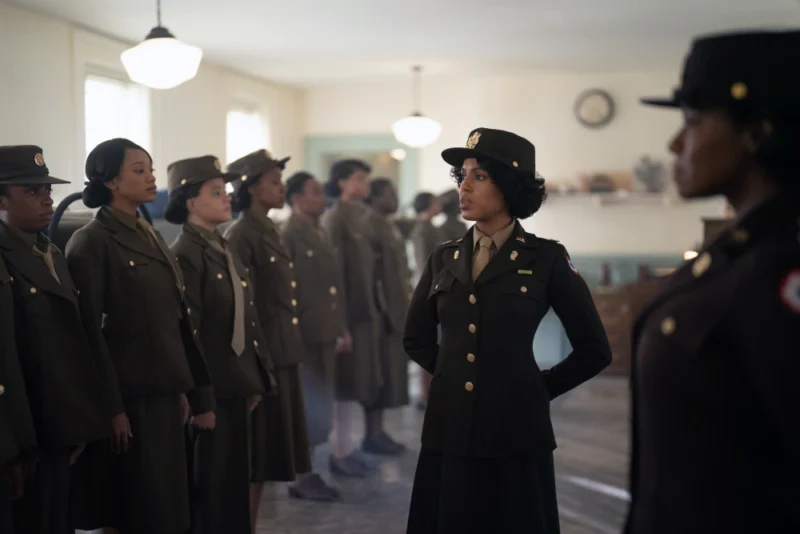
The job was considered impossible: Clear 17 million pieces of backlogged mail. In a war zone.
Maj. Charity Adams knew it was a mission that could not fail, not just for the sake of morale of World War II troops, but also for the reputation of Black people in the eyes of the country’s top military brass. The real-life efforts of the 855 women of the Women Army Corps’ 6888th Central Postal Directory Battalion are captured in Tyler Perry’s latest film, “Six Triple Eight,” streaming now on Netflix.
To Kerry Washington, who portrays Adams, the battalion’s ability to resolve an ongoing problem in the face of discrimination while also being underestimated by others around them felt like both a herculean task and an all-too-familiar scenario.
“When these women were asked to solve this problem, it was a problem that lots of people had tried to fix, and nobody could,” Washington said in an interview with NBC News. “They came in and, as Black women do, they figured out how to fix a situation that seemed impossible to fix, and by doing so, they returned hope and purpose and belonging and love to the soldiers to help end the war.”
Mary McLeod Bethune, head of the National Council of Negro Women and a member of what was known as President Franklin Roosevelt’s “Negro Cabinet,” whom Oprah Winfrey plays in the film, advocated for Black women to serve in the war. But while Black women were admitted to the military, they were segregated from white women and given very little to do. Because top military brass deemed Black people generally inferior, many doubted a successful outcome to clearing endless piles of mail.
[…]
The unit’s work had been forgotten by most — even Perry, the director, did not know about the 6888th’s work until producer Nicole Avant contacted him about taking it on.
During a Q&A last month after a screening of the film on his home turf, Atlanta, Perry told the crowd, filled with members of the National Association of Black Military Women, how meeting Lena Derriecott Bell King, then 99, a member of the 6888th, showed him that he could apply her life experiences to help tell the remarkable story.
Discover how this group has since been recognized.
Comments Are Welcome
Note: We moderate submissions in order to create a space for meaningful dialogue, a space where museum visitors – adults and youth –– can exchange informed, thoughtful, and relevant comments that add value to our exhibits.
Racial slurs, personal attacks, obscenity, profanity, and SHOUTING do not meet the above standard. Such comments are posted in the exhibit Hateful Speech. Commercial promotions, impersonations, and incoherent comments likewise fail to meet our goals, so will not be posted. Submissions longer than 120 words will be shortened.
See our full Comments Policy here.