It’s Bigger Than a Hip-Hop Exhibit: What the Controversy Around White Curators in Black Spaces Reveals
Share
Explore Our Galleries









Breaking News!
Today's news and culture by Black and other reporters in the Black and mainstream media.
Ways to Support ABHM?
by Anna Branigin, The Root
It wasn’t breaking news, by any means: Timothy Ann Burnside, a specialist in Curatorial Affairs at the National Museum of African American History and Culture, had been collecting hip-hop artifacts for the Smithsonian for years. But a discussion about her position and her work dominated parts of the Twittersphere this past weekend, as a long-simmering debate about white curators in black spaces came to a boil….
It’s hard to argue with Burnside’s qualifications. In their 2018 “Best of D.C. Issue,” Washington City Paper named her the “best cultural influencer you probably haven’t heard of,” noting that Burnside has been collecting “hip-hop and other cultural objects” for the Smithsonian’s hip-hop initiative since 2006. Speaking of her work, Burnside told the paper that visitors to the museums don’t see the “hours of site visits, conversations, research, and detailed preparation that happens before a collection is considered.”
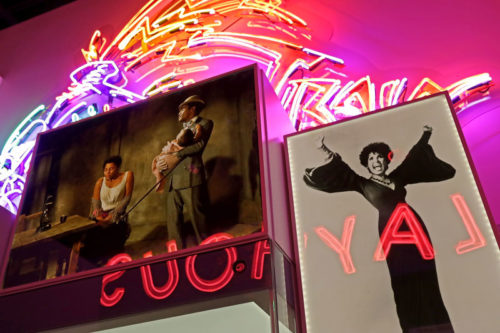
Photo: Chip Somodevilla (Getty Images)
But defenses of Burnside’s work missed a greater point: it’s impossible to talk about Burnside’s hiring without acknowledging the barriers to entry that exist for the art world’s “outsiders”—particularly in marquee spaces like the Smithsonian.
A similar debate was sparked earlier this year, when the Brooklyn Museum hired Kristen Windmuller-Luna, a 31-year-old white woman, to curate its African Art wing. A backlash ensued, prompting the Brooklyn Museum to write a statement defending their decision. Windmuller-Luna’s mentor, Nigerian-American curator Okwui Enwezor, came to her defense, admonishing her critics….
In both instances, though, art experts claimed there was a dearth of black curators able to fill such positions—and the numbers would seem to support that. According to an Andrew W. Mellon Foundation study (pdf), 85 percent of all curators are white. When it comes to positions “most closely associated with the intellectual and educational mission of museums,” the Mellon Foundation writes, only 7 percent of those jobs were held by black and Latinx curators.
But if there is no black candidate with Burnside’s credentials, isn’t that part of the problem? As The Root explored in an earlier piece, the lack of black curators points to deep systemic issues within the art world that have yet to be adequately confronted….
Read the full article here.
Read more Breaking News here.
View more galleries from the ABHM here.
Comments Are Welcome
Note: We moderate submissions in order to create a space for meaningful dialogue, a space where museum visitors – adults and youth –– can exchange informed, thoughtful, and relevant comments that add value to our exhibits.
Racial slurs, personal attacks, obscenity, profanity, and SHOUTING do not meet the above standard. Such comments are posted in the exhibit Hateful Speech. Commercial promotions, impersonations, and incoherent comments likewise fail to meet our goals, so will not be posted. Submissions longer than 120 words will be shortened.
See our full Comments Policy here.